Practical Advice for Transportation Cycling

Sometimes, all that matters is getting from Point A to Point B as cheaply, safely and efficiently as possible. You don't need a fast bike, you don't need a pretty bike, and most of all you don't need an expensive bike, you just need one that works.

Thursday, March 7, 2013

Of Bikes and Booze

Yes, you can buy 6-Pack carriers on Etsy
With St. Patrick's Day rapidly approaching, and many folks preparing for a weekend of whiskey-fueled celebration (ironically enough, since I play Celtic music, it's the one weekend I have to stay sober so I can work), I figured now's a good time to talk about drinking and cycling.

Most cyclists I know enjoy their adult beverages as much, if not more than their caffeinated ones (and they LOVE coffee), in fact, it's been said that the perfect group ride starts at a coffee shop and ends at a brew pub (cyclists love their microbrews, and apparently, microbrews love us back). Additionally, it seems like component and tool designers are compelled to put bottle openers on every possible piece of equipment, from multitools to baskets, and even incorporate them into the bicycle frame on occasion. Bikes and booze are pretty good buddies.

It seems like the health benefits of bike riding, along with the health benefits of (moderate) alcohol consumption go hand in hand, and the social aspect of wrapping up a strenuous ride by enjoying a couple of tasty beverages together is a great bonding experience. A post-ride pub stop can turn a dreary, foul-weather ride into an epic adventure, and a pleasant ride into a fantastic outing.

Furthermore, in areas where there are several brewpubs or vineyards to be found, a bicycle can be the ideal way to tour them. Riding along gives you a chance to enjoy the scenery whilst burning off the calories (and alcohol) between one stop and the next.

The key, of course, is moderation. In many areas it's illegal to operate ANY vehicle while intoxicated, including a bicycle. If you're really drunk, your perception and balance will be impaired, which means taking to the streets to dodge traffic is not a good idea at all. A lot of fatal bicycle accidents in urban areas are due to drunk riding. There are those who feel that if they're just a bit buzzed, riding a bicycle is far safer than driving, which considering the slower speeds and better maneuverability of a bike compared to a car is probably true, but as a more-or-less responsible blogger who puts my real name on things, I can't ethically encourage riding impaired at all (if you do have to stumble home, walking your bike and leaning on it for balance is fair game).

If you happen to drive to the pub and have a few too many Saturday night, your best bet is of course to get a ride home from a friend or a cab. In this case, a Sunday morning bicycle ride may be your best friend (along with Gatorade and Advil). I've... heard that in the case of a mild hangover, working up a sweat in the morning can help clear it up much more quickly, and a leisurely ride to go pick up your car from wherever you left it might be just what the doctor ordered.

Bikes, beer and wine have a long-standing, mutually beneficial partnership, so go on and have a pint after your ride, just be moderate and responsible.

Cheers!

Tuesday, March 5, 2013

Accessories and Upgrades

I've said before that all you really need for bicycle commuting is a working bicycle and somewhere to go. This is true, but there are a number of accessories and add-ons that add function and comfort to riding. There are also any number of upgrades you can make to the stock setup of your bike to make it just a bit better. Some of these are worth the money and effort, some of them are, in my opinion a waste.

Some of these I've talked about in detail with individual posts, others I intend to get to in the not-too-distant future. Right now, I'm just going to list a few things that I think are worth looking into.

Accessories - Stuff you add to your bike, or carry with you


Multitools: You should have one and know how to do at least basic fixes and adjustments. You don't have to be a master mechanic, but knowing how to adjust your seat height is only reasonable.

Minipump: Are you going to ride farther from your house than the distance you'd like to walk? Bring an inexpensive portable pump, clipped to your frame or in your bag.

Spare Inner Tube: Goes with the pump above, it's much easier to replace the whole tube in wet or cold weather than to use a

Patch Kit: On long rides, it's worth carrying a spare tube AND a patch kit, in case of multiple flats (it happens, replace the tube first, but save the old one in case you get a new hole, that way you have to potentially patch-able tubes). Traditional patch kits work well, but can be messy. "Glueless" patch kits are compact and easy to use, but the patches may not last as long (they'll hold up for a month or two, certainly long enough to get you home).

Tire Levers: Complete your flat-fixing kit with some levers. These will help you get the tire off the rim without damaging it or yourself.

Fenders: If you're riding in anything but dry weather, at least some sort of rear mudguard will keep your rear end from getting soaked. Full fenders are worth their weight in gold if your bike will fit them.

Lights: From dusk till dawn, you need 'em. Simple clip-ons are fine for just being seen, but higher-wattage lights up front will help you see where you're going if you venture beyond the streetlights. Truly bright front lights are pricey, but new LED and battery technology means they're both brighter and cheaper than ever, and you can get a lot of Lumens for under $100. Battery power is still the way to go on a budget, but if you find yourself with a few hundred dollars extra, you could do worse than to throw it into a front wheel with a built in dynamo hub.

Racks: Rear racks are pretty ubiquitous on commuter bikes, and will let you sling bags or bungee cargo on board. A front rack isn't a bad idea if your bike will take one. A front rack will let you keep an eye on delicate cargo or give you a stable platform to attach a basket.

Baskets: The cheapest and simplest way to make a bike into a practical vehicle is to slap on a basket. Suddenly, you can carry stuff without a backpack or messenger bag, and the simple, open-top convenience of a basket means you don't even have to think twice about grabbing some groceries on the way home.

Bottle Cages: If you're riding more than a mile or two, especially in the summer, the ability to carry at least one water bottle in an easily accessible spot is wonderful.

Bell: One of the least-often enforced traffic laws in most areas is the requirement that bicycles have an "audible signaling device," such as a bell or horn. You can skip this one at your discretion, but if you ride on a multi-use path at all, where you've got walkers, joggers and slower riders, you'll get tired of yelling "excuse me" every time you want to pass. A bell will save your vocal chords a bit.

Bags (on the bike): There are any number of bicycle-mounted bags to choose from. The most common are small under-seat bags that hold your multitool and spare tube, but you can also get ones to carry touring gear, groceries, maps, laptops and whatever else you need. Size, price and mounting configuration will vary based on your needs and your budget.

Bags (on you): A backpack or messenger bag can be handy if you need to carry stuff with you once you're off the bike. If you lock up somewhere where stuff is likely to be stolen, keeping even your tools and pump in a bag is a good strategy. On-the-body bags can lead to sore shoulders on long rides, and sweaty backs on hot days, but sometimes bags can be clipped to racks or dropped into baskets to avoid this.

Lock: It's nice to come back and find your bike where you left it. A sturdy lock is a necessity for most of us.

Mirror: If you're comfortable looking over your shoulder without swerving out into traffic, you don't need a mirror on your bike. Otherwise, you'll probably feel safer using one. Even cyclists who don't normally feel the need for a mirror might benefit from one if they're riding a loaded touring bike, tandem or bike with a child seat.

Upgrades - Things already on the bike that are worth making better


Saddle: The stock saddles on most low-end bikes tend to be squishy foam things, which can cause pressure points and chafing on longer rides. You may find the factory default is good enough, but if not, this can have a huge effect on your comfort, so don't be afraid to swap for better quality.

Pedals: If they're plastic, chuck 'em. Metal-bodied pedals last much longer and can take more of a beating. My favorite pedals for commuting are big, grippy BMX-style pedals, that give you a nice supportive platform no matter what shoe type you're wearing and how big your feet may be.

Grips: If you're going to ride in wet weather often, mountain bike grips may start to come loose over time. Lock-on grips can prevent this. For long commutes, ergonomic grips are a nice, if geeky-looking option.

Wheels: Better, stronger wheels can make your bike more durable and pleasant to ride. Double-wall rims are a must for heavier riders.

Stuff you DON'T need:


Cyclometer/Bike Computer: Some folks like to know how far they've gone, or how much time they've put in, or whatever, but unless you're training for a race or for fitness, you don't NEED one of these. Personally, when the battery died on mine a couple years ago, I took it off and haven't missed it.

Smartphone Mount: I consider trying to talk on the phone while biking the same as trying to do it while driving. You need to pay attention, so turn off the ringer, toss the phone in a bag or pocket and enjoy the ride. Also, don't ride with headphones in, whether for your phone or a music player. If you don't hear that car coming behind you and slowing down, how are you going to know he's about to make a right turn in front of you?

Tires: Ride whatever is on the bike until they're bald, then replace them. Don't worry about whether they're the "perfect" tires for the season or for you local streets. As long as they're not lightweight race tires, they're fine for commuting. When they do wear out, get cheap, sturdy tires with a some sort of flat protection built in.

Tire Liners: Unless you live somewhere with a lot of cactus thorns, these "flat protection" strips are more trouble than they're worth,and often end up causing flats themselves, as they pinch against inner tubes. Get tires with a built-in flat protection strip if you can, or just don't worry about it.

Slime/Tire Sealant: This (usually green) goo claims it will prevent you from losing air from punctures. It does work, but only on very small holes and slow leaks. What it usually does in reality is ooze all over the place between the inner tube and tire and make a huge mess. Sometimes it also jams up the valves. If you have a problem with small debris puncturing your tires, you're better off using heavy-duty tubes and tires with some flat protection. I've seen tubes full of sealant leak so bad that otherwise perfectly good tires had to be thrown out with the flat inner tube, because the sticky mess was impossible to clean up.

Toe Clips and Straps: If you're racing or doing "sporty" rides, get clipless pedals, which mate to special shoes and click in like ski bindings. If you're commuting, use plain flat pedals. To get any sort of efficiency benefit from toe straps, they have to be tight enough that you'll have trouble getting out of them in a hurry. If they're loose enough to get out of easily, you're not getting any real benefit from them, but still risk wrenching your ankle if you take a spill (modern clipless pedals are designed so you'll pop out in a crash, toe straps just hold on until you tear a tendon). You don't gain much performance benefit from being attached to the pedals (it's worth it if you're racing, for commuting, not so much) and trying to pull up on the pedals to get extra power doesn't actually help at all (it costs you efficiency on the side that's pushing down) and can actually result in some pretty nasty ankle injuries (more torn tendons).

Aero Bars: If you're doing a triathlon or time trial, clip on aero bars can be helpful, otherwise, you're usually better off without them. People sometimes see them and think "oh, an elbow rest, that must make riding way more comfortable" without realizing "hey, to rest my elbows on there, I have to lean over WAAAAY further than I would usually go." Even if you are more comfortable with them, your still in a poor position to reach the brakes quickly, or to control the bike (which is why they're banned from any racing that's done in a pack, they're only legal for certain circumstances where riders are spread out, otherwise, they cause crashes).

Saddle Pads: Extra cushion that goes over a saddle, often with some sort of gel or foam. A lot of the time, these things start to slide all over the place and make the saddle feel more uncomfortable or awkward, especially cheap ones. Better quality saddle pads cost as much as an inexpensive saddle, and are still prone to sliding around. You're better off just replacing the seat if you're unhappy than trying to pile more stuff on top of it to get comfortable.


Monday, March 4, 2013

Big Guys on Bikes

Bicycle racing, at the professional level, is dominated by relatively small slender men. Cycling is a primarily aerobic sport, and extra mass, even muscle mass, is just more weight to carry over those hills.

But commuter cyclists come in all shapes and sizes, from flyweights who could (and maybe do) race at a competitive level to those who are often referred to as "Clydesdales," riders over 200 lbs. Personally, at 6'3" and well over 200 lbs I fall pretty firmly into that latter category, which makes me something of an expert in setting up bikes for big riders.

Except in the case of ultralight racing gear, the choices big guys (and girls) make aren't too different from those made by more average-sized riders, but there are a few things that are worth knowing or looking into.

First off, bicycles rarely have a posted weight limit, except in three cases. The first are lightweight racing-style bikes, which sometimes have a limit of around 180 lbs (this would be huge for a professional bicycle racer). The second case is folding bicycles, which have complicated frames with folding joints and long, unsupported seatposts. Folding bike weight limits are often in the 220 lbs range. The final category of bikes with posted limits are cargo bikes, that are often described as being able to carry x lbs of combined rider and cargo weight. These limits are often upwards of 400 lbs, and shouldn't concern any but the very largest of cyclists.

Other bikes don't have a posted limit, and if pressed, most manufacturers will usually hedge by saying something like "riders over 250 lbs should use caution" or "they're fine up to at least 300 lbs" but really it's hard to say how heavy is too heavy for a bike to carry (even the posted limits on bikes that have them are somewhat arbitrary, mostly to please insurance and warranty issues), since your riding style, terrain and sometimes luck will have a lot to do with how much strain you put on a bike. For example, a 300 lbs rider might ride a folding bike that has a much lower suggested rider weight for years without issue, but if he should bend the seatpost by hitting a pothole, the manufacturer can refuse to offer a warranty replacement.

Generally though, big riders can ride the same bikes as anyone else, but can also expect to wear stuff out faster. Tires, chains and brakes pads are all items that wear over time, and the bigger you are, the fewer miles you can expect to get out of them.

Super-lightweight parts are best avoided (if you're commuting, avoid them anyway), and if there's one part of the bike I would recommend a heavier rider put extra attention and money into, it would have to be the wheelset.

Wheels suitable for a heavy rider are  not necessarily the most expensive ones out there (those are often super lightweight and designed for racing, therefore a poor choice) nor are they the cheapest ones. Most entry-level mountain or commuter bikes, for example, come with inexpensive wheels with single-wall aluminium rims. These are adequate for the average rider, but will be far more likely to suffer issues with a heavier rider. Instead, look for wheels the next step up with double-walled rims. These will be much stronger, stay in true better and have fewer broken spokes. (I have a photo around here somewhere illustrating the difference between double- and single-walled rims, I'll upload it when I can find it, but the major thing is that a single-walled rim has a "U" shaped cross section, but the double-wall adds another piece of metal, like a cross-brace across the "U", making for a stronger, stiffer rim).

Wheels with lower-spoke counts are also  not worth a big rider's time. 32-spoke or 36-spoke wheels are the way to go. One innovation from the racing world that is worth considering are deeper-cross-section rims. These rims are designed to be stiff and strong with 16 or 24 spokes, if they're built up with 32 or 36 spokes they are pretty bombproof (you may have trouble finding stock wheelsets built up this way, I build a lot of my own wheels specifically so I can get the combination I want). Wheels made for touring bikes or tandems are good off-the-shelf options for road bikes, while heavy-duty mountain bike wheels are not hard to find at all at a reasonable price.

Fatter tires are also an asset to the heavy rider. More air volume means more cushion and less likelihood of a pinch flat. Most mountain bike tires are fat enough, but big riders should make sure they're always pumped towards the higher end of their pressure range. On a road bike, or bike with 700c wheels, 32-38mm tires are great. Many road bikes won't fit more than a 25 tire width, in which case, go with the biggest you can fit, and pump it up to the max recommended pressure.

On other parts of the bike, use common sense. Replace plastic pedals with metal, and avoid saddles that are too squishy (you'll bottom out). Suspension forks may cause problems for the big rider, if they're non-adjustable, expect them to be too soft and prone to bottoming out just from your seated weight. If they are adjustable, their highest tension/pressure setting may or may not be stiff enough for the best ride quality.. Rear suspension bikes are best avoided entirely unless your willing to spend well over $2,000. Overall, the simpler the bike is mechanically, the more likely you are to be happy with it.


Friday, March 1, 2013

Opinionated Blogger Friday: The Unracer

Ah, bicycle racing. It's a strange sport, obsessed as much with technology as with athleticism, riddled with doping scandals, melodrama and clashing egos. It's a fringe sport in America, seizing the public consciousness only in the case of major events or when a when there's a major meltdown.

The vast majority of commuter cyclists have never, and probably never will, raced. Some have dabbled in racing, and do the occasional local event, while others are enthusiastic amateur racers who incorporate their practical rides into their training routines.

Then there are the Unracers, utility and recreational cyclists who view racing as an abomination on the cycling world, a plague that infects bicycle design and renders otherwise beautiful machines unfit for practical use. Rather than sneering at heavy tubing or outdated parts, like the Weight Weenie, the Unracer eyes your too-low stem and too thin tires dismissively and wonders when you're going to get a "real" bike.

Many Unracers have never raced, but quite a few are former racers, who tired of the competitive world and now ride for practicality and enjoyment. One of the best known, and well spoken of the "reformed racers" is Grant Petersen, founder of Rivendell Bicycles. Petersen may have actually coined the term "unracing" to describe his current approach to bicycle design. In his book "Just Ride" he discusses the joy of just riding to for the sake of riding, and an approach to cycling and to bicycle design that prioritizes practicality and comfort over speed.

I have quite a bit of respect for Petersen, and find myself agreeing with him more often than not, but find I differ with him on the emphasis on not racing. By dismissing racing and fast riding, I think the Unracing movement misses out on one simple point: going fast is fun.

I think consumers do need to understand that a bike designed for competitive riding may not suit their everyday commuting, touring or leisure riding needs, but they need to understand that in the way they understand that a two-seat convertible is not the ideal vehicle for grocery shopping or taking the kids to the movies. Racing bikes aren't inherently bad, in fact, they're really well-designed to do what they do, which is cover a lot of ground as quickly and efficiently as possible. They're a lot of fun to ride, even if you're not a competitive type. On the other hand, just like that little deuce coupe, you might not want to make one your primary means of transport, racing bikes suck at carrying groceries.

Racing bikes are fun as both toys and sporting equipment. They're good for racing, and for fast, sporty riding. Regular, non-racing road bikes are good for a lot more things. You can stick on fenders and a couple bags and ride to work, or the store, you can take them on tour, go for a leisurely cruise, or, if you're not ultra-competitive, you can strip of the bags and racks and race them a bit. If you can only buy one bike, don't buy the racing bike, buy the all-around road bike.

You can be a racer, or you can not be a racer, but don't fall into the trap of defining yourself by what you're not. Don't be an "unracer," just be a cyclist.

Thursday, February 28, 2013

The Difference Between Boys and Girls

Do you think anyone who didn't know you would notice if you borrowed your significant other's car? Unless you've got a spouse who drives something... unusual, nobody would be likely to notice at all, because, for the most part, cars don't have gender-specific designs (yes, they do tend to be marketed at different demographics, including by age and gender, but you can still drive your mom's car and only your close friends will laugh at you).

Bicycles have traditionally been different. First off, because the rider is also the engine, bicycle design has to be adapted to human anatomy, and bikes usually come in different sizes to fit taller or shorter riders (yet another reason to avoid department store bikes unless you're exactly average). But bicycles have also long had different designs based on gender, as well.

Jamis Hudson, Men's Frame

Jamis Hudson, Women's Frame
Women's bicycles have long been offered in a "step-through" design, the roots of which are based more in fashion than in practicality. Back when bicycles first became popular, in the late 1800s, women were expected to wear skirts, regardless of what activity they were engaged in The step-through frame of a women's bicycles allowed them to mount the bicycle without having to swing a leg high over the saddle, and to ride without the skirt bunching on the top tube.

The bicycle, in fact, had a fairly large affect in the turn-of-the-century women's movement, as it offered both increased personal mobility for middle-class women and a reason to encourage Rational Dress over the more restrictive garments typical of the time.

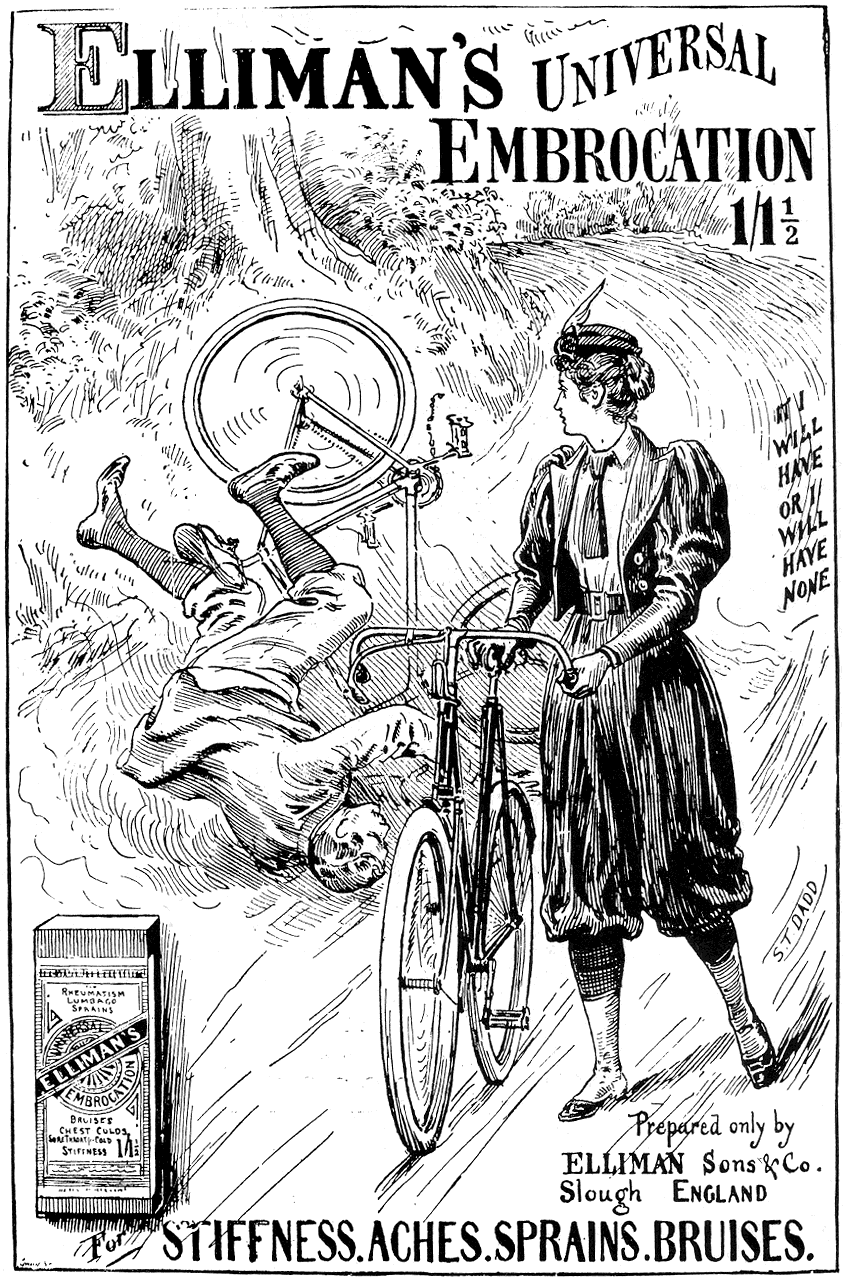
Advertisement from 1897 featuring a woman in cycling costume. Notice the baggy trousers to provide a skirt-like profile. 
The role of the bicycle in women's rights is a fascinating topic, but a bit beyond the scope of today's blog post. What's important for now is that, in spite of women's hard-won right to wear bifurcated garments in public becoming accepted fact, the design of bicycles made with women in mind reflects the preference of the day.

The diamond shape of the typical men's frame is a bit simpler to make, and provides more strength and lateral stiffness than a step-through frame of the same basic design, as well as more room to mount accessories and water bottles. As the men's market for sport cycling has commonly been bigger, diamond-framed bikes also were offered at higher price points and with better components than those available on step-through bikes. Because of this, female athletic cyclists often chose to ride "standard" bikes rather than a supposedly female-specific design.

In recent decades, as the percentage of women in competitive and sport cycling has grown, and with it market demand for performance-oriented bikes for both halves of the human race, a new type of "women's-specific" bike has emerged. These bikes have a design similar to standard bicycles, but with the geometry and proportion altered slightly to take into consideration the common physical differences between men and women.

Jamis Satellite and Satellite Femme (no, I'm not paid by Jamis, I just work at a shop that sells a lot of 'em so I have access to pictures).

The assumption being that compared to a man of the same height, a woman would typically have longer legs, a shorter torso, narrower shoulders, slightly shorter arms and smaller hands. As a result, the bike would have a shorter top tube in proportion to its seat tube, narrower handlebars and sometimes smaller brake/shift levers.

Of course, this design relies on sweeping generalizations, as not all women are proportioned the same. These fit some female cyclists (and on occasion, a shorter male cyclist) very well, and others not at all. Many women are fine riding a standard bike, or a standard bike with some modifications. Still, it's a useful option for those who haven't been able to find a standard-geometry bike to suit their needs.

But back to the "boys and girls" or rather "standard and step-through" frame designs. Is there a need for modern women to ride a step-through frame, or any reason a man shouldn't? Aside from fashion, the answer is, as you may expect "do whatever you feel like." Some men might feel a bit self-conscious riding a pink, step-through bike, but fortunately, most manufacturers offer step-through frames in at least one gender-neutral color (black).

There are a few very good reasons to choose a men's (standard, diamond-frame) bike, including:

  • Greater strength and rigidity
  • More room for water bottle cages, bags and pumps inside the frame triangle
  • Easier to hang on a car-mounted bicycle rack
On the other hand, advantages of a women's (step-through) frame include:
  • You don't have to swing your leg over it like a dog over a fire hydrant, which if you've got hip problems, is nice. 
  • If you're carrying a large rear load, or have a child seat on the back of your bike, it's much easier (and safer in the case of the kid carrier) to mount a step-through frame
  • The lack of a top tube makes the bike more adjustable to fit a wider range of riders, handy if it's a "guest" bike (and the reason that most bike-share bikes are designed this way). 
There are also bikes which are designed specifically as a unisex design with a step-through or low-standover frame, called mixtes (pronounces that... however you want, it's French). Mixte bikes traditionally have a double top tube that runs at a diagonal from the head tube to the rear dropouts, a design which results in a stronger, stiffer frame than a "ladies" step-though. 

 Modern Mixte by Soma Fabrications
These types of bikes are a good choice for those who want the ease of mounting but want either a stronger frame or something a bit less "girly" looking. 

What it really comes down to, is that you have to find a bicycle that fits you, and suits your needs, regardless of fashion or tradition. There's no reason to buy a "women's" bike if you don't want one, but on the other hand, there's no reason not to if that's what you think is the most sensible option. 

Wednesday, February 27, 2013

Those Words We Use

Yesterday I posted about bike "saddles," preferring to use that term rather than "seat" for reasons of custom and, as a matter of fact, clarity (a "seat" implies you sit on it, legs in front like a chair or bench, a "saddle" is something you straddle like the thing on a bicycle or a horse).

But while you sit on a saddle, the saddle itself sits atop a seatpost, which made me realize that there are a ton of terms and jargon used in the bike industry that probably make no sense to anyone who hasn't been behind a shop counter. While I try to avoid using any more bike-specific jargon, there's a few terms to know that are helpful, not only to follow along on mine or other bike-related pages on the internet, but also to be able to communicate clearly with your bike shop.

I'm not going to to try to put together a comprehensive bicycle glossary, but give you a few of the most useful terms. For something more completist, see Sheldon Brown's work here.

By Category, rather than by alphabet:

General Terms:

Road Bike: A bicycle made for pavement riding. Built for light weight and aerodynamic efficiency, with narrow tires, a leaned-forward riding and no shock absorbers. Usually has drop handlebars and integrated brake-shift levers on newer models.

Mountain Bike: A bicycle made for off road use. Features fat tires with tread meant to grip on loose surfaces, and lower gearing than a road bike. Usually has at least a front shock-absorber, may also have one for the rear wheel.

Hybrid Bike: Made to be something between a road and mountain bike, often has straight handlebars and gearing higher than a mountain bike, but usually lower than a road bike. The tires will be fatter than most road bikes, but not have the tread design of an aggressive off-road machine.

Sport-Comfort Bike: Industry term for a type of hybrid bike that has mountain-bike sized (26") wheels. Often looks like a mountain bike, but with much higher handlebars, a cushier seat and smoother tire tread.

Flat-Bar Road Bike/Fitness Bike: A type of hybrid that is close to a road bike in geometry, gearing and tire size, but has straight handlebars and a more upright riding posture. Usually less expensive than a road bike due to simpler shifting mechanisms.

City Bike: Any bike designed for urban riding, usually some sort of hybrid.

Cruiser: A bike with very fat, low-pressure tires, a wide seat, dramatically swept handlebars and a very upright sitting position. Comfortable for short rides, but not ideal for getting up hills. Often referred to as a "beach cruiser" because of their popularity in flat, coastal areas and on boardwalks.

Touring Bike: A bike made for long-distance rides from one point to another, usually a variation on a road bike, but sometimes a hybrid or mountain bike. May be set up to carry heavy loads including camping gear, but some carry little more than a change of clothes and snacks.

Handlebars:

Stem: The thing that attaches the handlebars to the bicycle. Comes in two flavors, Threadless (clamps onto the outside of the steering tube) and Quill (slides into the steering tube and fastens with an expander bolt).

Drop Handlebars: Road and racing bike handlebars that curve downward in a "ram's horn" shape.

Flat Bars: Straight handlebars

Riser Bars: Handlebars whose shape curves upwards from where they're clamped into the stem.

Bar ends: things that clamp onto the end of flat bars to give you an extra hand position

Aero Bars: extensions that allow you to lean forward with your elbows and forearms resting on the handlebars. Done for aerodynamics, not for comfort.

Grips: The coverings (usually rubber) that go on the handlebars to make them more comfortable for your hands

Bar Tape: a padded tape that wraps around drop bars to provide a gripping surface and some cushioning.

Brakes:

Brake Lever: The thing on the handlebar that you move to activate a brake

Coaster Brake: A type of brake contained in the rear hub of the bike, activated by turning the pedals backwards. Common on cruiser bikes and some city bikes.

Caliper Brake: A "U" shaped brake, common on road bikes, that attaches to the bicycle with a single bolt and grabs the rim of the wheel.

Cantiliver brake: A type of rim brake that attaches with two bolts, one on either side of the bicycle frame or fork. Comes in two flavors, Centerpull (a cable straddles the two brake arms, and another cable pulls upwards on it to pinch them together) or Linear Pull, aka "V-Brake" (the brake cable runs through the side of one arm and attaches to the other).

Disc Brake: A metal disc attaches to the center of the wheel. Brake calipers grab the disc rather than the wheel itself. Similar to brakes on cars or motorcycles, just smaller and more lightweight. Two flavors again, mechanical (a cable pulls a lever on the brake which moves the calipers) or hydraulic (uses special brake lines full of fluid, much like a car).

Brake cable: The cables that connect the brake to the brake lever. Usually made of a wound steel wire running through some sort of flexible housing made of metal coated in plastic. The cable and the housing are sometimes referred to as "inner and outer cable". Housing may be "full" (runs from the lever to the brake, covering the inner cable all the way) or interrupted (it ends in special brackets on the frame of the bike, leaving sections of inner cable exposed).

Brake Pads/Brake Shoes: The part of the brake, usually made of some sort of rubber compound, that grips the wheel to slow or stop it. Because of the friction involved, these are the quickest-wearing part of the bike. Easily replaced, and usually inexpensive, but you need to make sure you get the right style of pad for the type of brake you have (best bet is to bring the old, worn-out pad with you to the shop).

Wheels:

Wheel: The whole wheel, all the parts put together

Tire: The rubber part part that touches the ground. Will have different tread designs depending on use. Comes in many sizes. The thickness of tires can vary, but the inside diameter must match the wheel on which it is to be mounted. Making sure you have the right tire size can be really difficult, especially on older bikes, as there are a wide array of them, and they weren't well standardized till recent decades.

Tube/inner tube: The balloon-like thing inside the tire that holds the air. Usually, flats mean replacing the inner tube. Inner tubes are sized to match tires. Has a valve to put air in, which projects through a hole in the wheel.

Hub: The center of the wheel, which rotates around the axle.

Axle: The rod that runs through the center of the wheel and attaches it to the bicycle. The part of the wheel that doesn't spin. May use nuts or a quick-release mechanism to make it fit tightly.

Rim: The outer edge of the wheel, on which the tire mounts. Usually aluminum or steel.

Spokes: The rods that connect the hub to the rim. Tension on these keeps the wheel even, and minor irregularities can be worked out by adjusting the tension on specific spokes. The little widget that threads on one end of the spoke to attach to the rim and adjust tension is called the nipple.

Drivetrain: 

Pedals: The little platforms on which you rest your feet

Crank: The assembly which transfers the movement of the pedals to the bike. Made up of two crankarms, a spindle to connect them and from one to three toothed sprockets called chainrings

Bottom Bracket: The bearing assembly attached to the bottom of the bicycle which allow the crank to rotate. The crank spindle is often attached to the bottom bracket, but not always.

Chain: the chain. Varies in width depending on how many gears are in the rear cluster. The wrong chain can lead to jammed drivetrains.

Freehweel: A type of gear cluster which screws directly onto the hub. The ratchet mechanism is contained in the freewheel itself, rather than part of the rear hub.

Cassette: A type of gear cluster which has no ratchet mechnism, attaches to a "freehub" rear hub, where the ratcheting mechanism is contained within the hub body itself.

Derailleur: The device which moves the chain from one cog to another. Front derailleurs mount by the cranks and move the chain from one chainring to the others, rear derailleurs hang below the rear axle and move the chain around the cassette or freewheel.

Shifter: The gadget on the handlebars (or sometimes, on older bikes, on the frame or stem) that controls the derailleurs by pulling on a cable. Cables are similar to brake cables above, but have different ends.

X-Speeds: When speaking about how many "speeds" a bike has, we refer to how many gears are on the rear cluster, because this affects shifter and chain choice. Bikes can have between one and 11 cogs in the rear, therefore in modern terminology, a "ten-speed" bike is a bike with ten rear cogs, and one, two or three chainrings (10-30 possible gear combinations). Front choices are called single, double, or triple, depending on how many chainrings there are. Therefore, a bike with two chainrings and nine cogs in the back would be referred to as a "9-speed double."
 This may seem counter-intuitive, but it makes finding parts and repairs a lot clearer (for example, if you say you have an "18-speed" does that mean you have a bike like that above or one with six rear cogs and three chainrings? Both exist, but the parts are not compatible at all). Most entry-level mountain bikes are 7-Speed triples.

Internal Gears/Gearhubs: The gearing mechanisms are all contained within the rear hub, withe no derailleurs. Between two and 14 gears are possible, and infinitely variable gearhubs exist.
Frame:

Frame: The skeleton of the bike. Often diamond shaped, but there are variations.

Fork: The part of the bike that holds the front wheel. Consists of a steer tube (central part which goes through the frame to connect to the stem), crown (part where the fork splits), legs or blades (go on either side of the wheel) and dropouts (fittings where the axles attach. Mountain bike forks often have spring-loaded legs, in which case it's called a "suspension fork." Suspension forks are becoming common on hybrid and comfort bikes as well.

Head Tube: The tube at the front of the bike through which the fork's steer tube runs. The bearings in the head tube, which allow steering, are referred to as the "headset".

Top Tube: The tube at the top of the bike. May be parallel to the ground or angled.

Down Tube: The tube that runs down from the head tube to the bottom bracket shell

Bottom Bracket Shell: The tube, set perpendicular to the other tubing, through which the crank bearings run.

Seat Tube: The tube connecting the bottom bracket shell to the top tube. The seatpost slides in here, and is secured by a clamp just above the top tube (called, appropriately enough, the "seat clamp"). Often, when the size of a bike is given in inches or centimeters, it refers to the lengthy  of the seat tube. Longer seat tube=taller bike.

Seat stays: The twin tubes that run from near the top of the seat tube to the rear axle. May be two completely seperate tubes or joined in a "Y" shape before meeting the seat tube.

Chain stays: The tubes that run from the bottom bracket shell to the rear axle.

Dropouts: The place where the stays connect, containing fittings to attach the rear axle.

Bosses: any fittings attached to the frame to attach racks, brakes, water bottles or other accessories. Brake bosses usually look like posts sticking out of the frame or fork, whereas water bottle bosses are threaded nuts set into holes in the frame tube.

Hanger: fitting which attaches the rear derailleur to the frame. May be replaceable in case of damage.

Other:

Commuter: Sometimes used strictly to refer to someone who bikes to work, but as a broader term meaning anyone who uses as bike as transportation rather than just for sport. AKA "Transportation Cyclist" or "Utility Cyclist."

Racer: Someone who rides primarily to race, or to train for racing.

Fitness Cyclist: Someone who rides strictly for exercise.

Recreational Cyclist/ Family Cyclist: Someone who rides for fun, without specific fitness or transportation goals (most cyclists from other categories also ride recreationally).

Touring: Riding your bike to a destination at which you intend to stay overnight. Three-major categories of touring are "Loaded" (carry everything you need, including food and camping gear) "Credit Card" (carry just clothing and minimal gear, stay at hotels, B&Bs or friends' houses) and "Supported" (ride from site to site, but have someone else carry your gear, usually a tour company with a van).

MUP/MUT: Multi-Use Path/Trail, a place where cars aren't allowed, but bikes, walkers, joggers, etc are, as opposed to a dedicated bike path.

JRA: A bicycle-shop acronym for "Just Riding Along." Often used descriptively as in "bike makes a clicking noise JRA, check shifting," but sometimes used derisively when shop employees suspect a customer is lying to avoid admitting responsibility for damage, as in "customer says he was JRA when the rear derailleur spontaneously broke. Scuffed paint, gravel and ripped bar tape from apparently crashing the bike must have nothing to do with it."

Bummel: A somewhat-uncommon term probably used mostly just by me. Taken from Jerome K. Jerome's humorous cyclo-touring book "Three Men on the Bummel." It means a ride with no particular goal or destination, but a time limit. For example, if you have Sunday off, and if you hop on your bike and ride around all day just for the hell of it, you can be said to be "on the bummel." The same can be said if you have a few days off and go on an overnight trip, stopping when you see a likely motel or campground, not following a strictly planned route, but keeping in mind you've got to get to work on Monday. My favorite type of recreational riding, especially for day trips.
Tuesday, February 26, 2013

Getting to the Bottom of Saddle Choice

"Oh my god, that skinny little seat must be so uncomfortable!"

Every cyclist who rides a performance-oriented bike of one sort or another had heard that at some point, either from a complete non-cyclist or someone who rides an upright comfort bike. It's true, on the wrong bike, a narrow racing saddle would be completely inappropriate, but because of body position, sometimes a narrow perch works better.

Saddle choice is a very personal thing, as everyone's body is a bit different, but there are some generalities that apply to just about everyone.

  • Whatever saddle you choose, it should allow your weight to rest primarily on the bony points at the bottom of your pelvis, known as ischial tuberosities or "sit bones." 
  • Very soft saddles are like very soft mattresses, comfortable for a short period of time, but over a longer span will often create more pain than they cure. Overly squishy bike seats often result in pressure points, numbness and chafing. 
  • Too-hard saddles also cause discomfort and chafing, most riders come to prefer saddles that are firm and supportive, but not rock-hard
  • The more upright you sit, the wider you tend to want your saddle
  • The more leaned-over your riding position, the narrower you tend to prefer your saddle
  • Whatever shape of saddle you prefer, it shouldn't interfere with your ability to pedal smoothly
  • The angle of the saddle should be roughly parallel to the ground. Depending on a number of factors, you might find having the nose of the saddle pointed slightly down or slightly up to be most comfortable, but the key word is "slightly."
My own personal preference for an all-around comfortable saddle is the Terry Liberator, which I feel provides a good balance between cushion and support, is wide enough to give you a good platform without being so wide it gets in the way and has a center cutout which eliminates pressure and chafing regardless of what clothes you're riding in. I am also a fan of Brooks-style traditional leather saddles, which, although fairly stiff, have just enough flex to them for comfort, and mold to your posterior over time. I currently have leather saddles on a couple of my bikes, in particular ones sold by Velo-Orange, which, while they don't have the cachet of the Brooks, are a good value and hold up well. Leather saddles also have the additional benefit of having bag loops mounted on the back, which allows the use of a traditional saddlebag. 

Many comfort and hybrid bikes come with a relatively wide saddle, often with springs or shock-absorbers of some sort. These can be very comfortable on an upright commuter bike, and the springs can help soak up the jolts one feels while sitting in a very upright position (when leaned over in a sportier position, the legs and hands help take impacts, but as you sit more upright, more of your weight is placed straight down on your sit bones, so a bit of spring can be a blessing). Ideally, for an upright ride, a somewhat wide seat with springs and just enough padding or flex would be the way to go. A Brooks B-67 seems like a great option for this type of thing, but is a bit pricey for me. Something along these lines is probably a more economical option. The only thing to be wary of is that you don't get a saddle that's TOO wide, otherwise what often happens is you creep forward as you pedal, so you end up sitting on the nose of the saddle, which becomes very uncomfortable very quickly. 

On modern style-saddles, like the Liberator, I do like a cutout or center channel for commuting. Not because, as some sources would have you believe, because I'm concerned with the center of the seat cutting off blood flow and causing impotence, but because I often ride in regular jeans or khakis. Non-cycling pants usually have a seam running right up the center of the crotch, and a bike saddle with a cutout takes the pressure of the seam, which otherwise could increase chafing and saddle sores. 

There have been numerous attempts to completely redesign the bicycle saddle over the years, and the idea of a "noseless" design comes up periodically but never seems to catch on (Jerome K. Jerome talks about such a design in his 1900 account of a cycling trip he took with his buddies, so it's not a new concept at all). I have tried a few variations on this design and found them all to be extremely uncomfortable and inefficient. Normal bicycle seats are, as they're called, a "saddle," you sit astride them with your legs on either side of the seat, whereas noseless designs tend to be more of a "bench." Because of this, your legs tend to push against the front of the seat when you pedal, which I've found has the effect of pushing your body forward off the seat. When I've tried to ride on this sort of seat, I always found myself having to push back with my hands on the grips to keep from sliding forward, which got tiring really quickly. There are some who claim that these noseless designs are very comfortable on upright cruiser-type bikes, but mostly I've seen them on bikes that don't get ridden (because the owner finds they have a hard time riding them comfortably). 

Choosing the right saddle for you often takes a bit of trial and error, and you can only take another person's preferences as a starting point, unless you happen to have an exactly identical derriere (how do you even check that?), but somewhere between big, cruiser-style "tractor seats" and minimalist nightmares like this, it's likely you can find something that suits your needs. You'll have to bear in mind, though, that even the most comfortable seat requires a bit of acclimation on your part, and you're probably going to have to suffer through a bit of getting "reacquainted" if you haven't been riding much lately. 

As Jerome said in Three Men on the Bummel, back in 1900 "There may be a better land where bicycle saddles are made out of rainbow, stuffed with cloud; in this world the simplest thing is to get used to something hard."