Practical Advice for Transportation Cycling

Sometimes, all that matters is getting from Point A to Point B as cheaply, safely and efficiently as possible. You don't need a fast bike, you don't need a pretty bike, and most of all you don't need an expensive bike, you just need one that works.
Showing posts with label choosing a bike. Show all posts

Thursday, February 28, 2013

The Difference Between Boys and Girls

Do you think anyone who didn't know you would notice if you borrowed your significant other's car? Unless you've got a spouse who drives something... unusual, nobody would be likely to notice at all, because, for the most part, cars don't have gender-specific designs (yes, they do tend to be marketed at different demographics, including by age and gender, but you can still drive your mom's car and only your close friends will laugh at you).

Bicycles have traditionally been different. First off, because the rider is also the engine, bicycle design has to be adapted to human anatomy, and bikes usually come in different sizes to fit taller or shorter riders (yet another reason to avoid department store bikes unless you're exactly average). But bicycles have also long had different designs based on gender, as well.

Jamis Hudson, Men's Frame

Jamis Hudson, Women's Frame
Women's bicycles have long been offered in a "step-through" design, the roots of which are based more in fashion than in practicality. Back when bicycles first became popular, in the late 1800s, women were expected to wear skirts, regardless of what activity they were engaged in The step-through frame of a women's bicycles allowed them to mount the bicycle without having to swing a leg high over the saddle, and to ride without the skirt bunching on the top tube.

The bicycle, in fact, had a fairly large affect in the turn-of-the-century women's movement, as it offered both increased personal mobility for middle-class women and a reason to encourage Rational Dress over the more restrictive garments typical of the time.
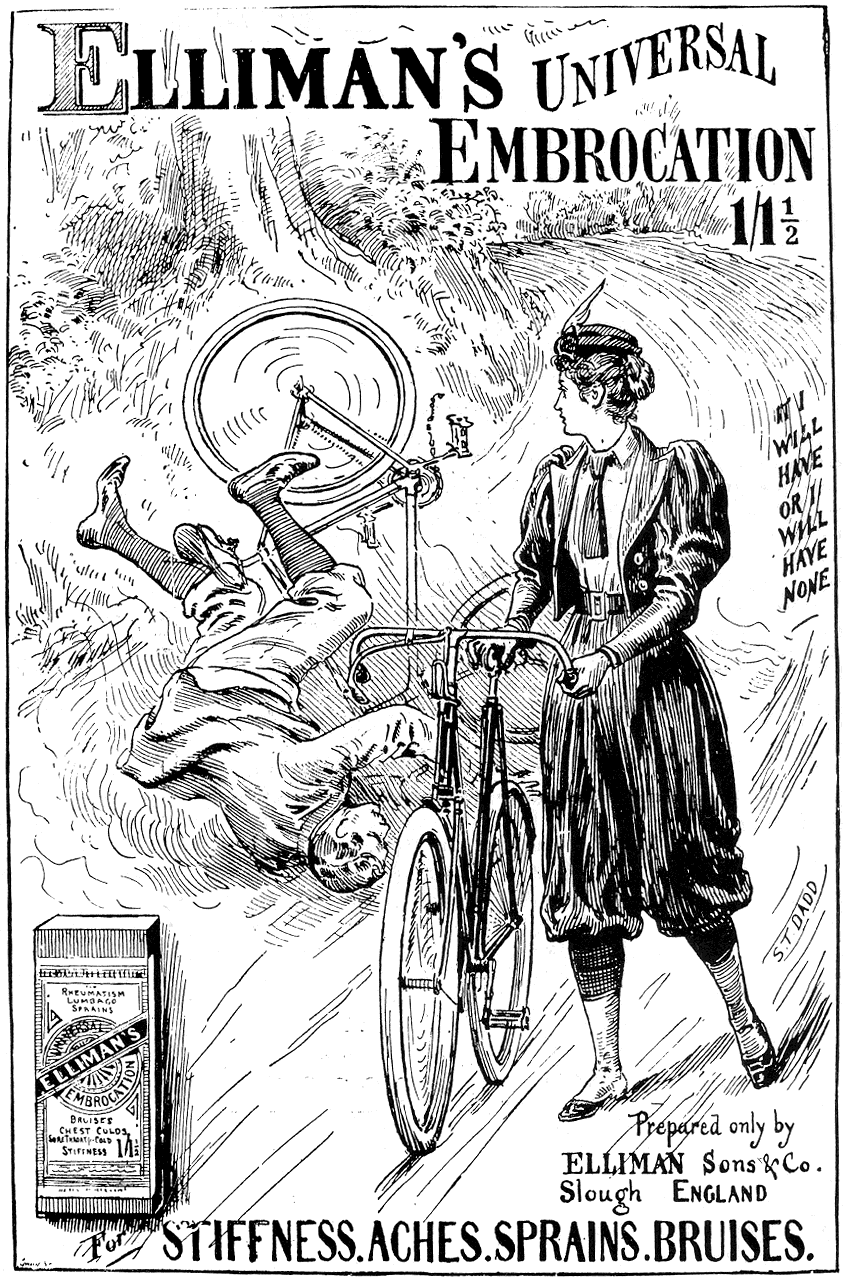
Advertisement from 1897 featuring a woman in cycling costume. Notice the baggy trousers to provide a skirt-like profile. 
The role of the bicycle in women's rights is a fascinating topic, but a bit beyond the scope of today's blog post. What's important for now is that, in spite of women's hard-won right to wear bifurcated garments in public becoming accepted fact, the design of bicycles made with women in mind reflects the preference of the day.

The diamond shape of the typical men's frame is a bit simpler to make, and provides more strength and lateral stiffness than a step-through frame of the same basic design, as well as more room to mount accessories and water bottles. As the men's market for sport cycling has commonly been bigger, diamond-framed bikes also were offered at higher price points and with better components than those available on step-through bikes. Because of this, female athletic cyclists often chose to ride "standard" bikes rather than a supposedly female-specific design.

In recent decades, as the percentage of women in competitive and sport cycling has grown, and with it market demand for performance-oriented bikes for both halves of the human race, a new type of "women's-specific" bike has emerged. These bikes have a design similar to standard bicycles, but with the geometry and proportion altered slightly to take into consideration the common physical differences between men and women.

Jamis Satellite and Satellite Femme (no, I'm not paid by Jamis, I just work at a shop that sells a lot of 'em so I have access to pictures).

The assumption being that compared to a man of the same height, a woman would typically have longer legs, a shorter torso, narrower shoulders, slightly shorter arms and smaller hands. As a result, the bike would have a shorter top tube in proportion to its seat tube, narrower handlebars and sometimes smaller brake/shift levers.

Of course, this design relies on sweeping generalizations, as not all women are proportioned the same. These fit some female cyclists (and on occasion, a shorter male cyclist) very well, and others not at all. Many women are fine riding a standard bike, or a standard bike with some modifications. Still, it's a useful option for those who haven't been able to find a standard-geometry bike to suit their needs.

But back to the "boys and girls" or rather "standard and step-through" frame designs. Is there a need for modern women to ride a step-through frame, or any reason a man shouldn't? Aside from fashion, the answer is, as you may expect "do whatever you feel like." Some men might feel a bit self-conscious riding a pink, step-through bike, but fortunately, most manufacturers offer step-through frames in at least one gender-neutral color (black).

There are a few very good reasons to choose a men's (standard, diamond-frame) bike, including:

  • Greater strength and rigidity
  • More room for water bottle cages, bags and pumps inside the frame triangle
  • Easier to hang on a car-mounted bicycle rack
On the other hand, advantages of a women's (step-through) frame include:
  • You don't have to swing your leg over it like a dog over a fire hydrant, which if you've got hip problems, is nice. 
  • If you're carrying a large rear load, or have a child seat on the back of your bike, it's much easier (and safer in the case of the kid carrier) to mount a step-through frame
  • The lack of a top tube makes the bike more adjustable to fit a wider range of riders, handy if it's a "guest" bike (and the reason that most bike-share bikes are designed this way). 
There are also bikes which are designed specifically as a unisex design with a step-through or low-standover frame, called mixtes (pronounces that... however you want, it's French). Mixte bikes traditionally have a double top tube that runs at a diagonal from the head tube to the rear dropouts, a design which results in a stronger, stiffer frame than a "ladies" step-though. 

 Modern Mixte by Soma Fabrications
These types of bikes are a good choice for those who want the ease of mounting but want either a stronger frame or something a bit less "girly" looking. 

What it really comes down to, is that you have to find a bicycle that fits you, and suits your needs, regardless of fashion or tradition. There's no reason to buy a "women's" bike if you don't want one, but on the other hand, there's no reason not to if that's what you think is the most sensible option. 

Tuesday, January 29, 2013

Choosing a Bike: Folding Bicycles

Not too long ago NJ Transit "clarified" one of their policies regarding bicycles on trains in a way that barred riders from bringing full-sized bikes through most of the stations in my area.

The policy has since been re-revised (now you just can't use full-size bikes at peak hours), but during the time it was in effect I got myself acquainted with a category of bicycle with which I didn't have much prior experience at all, the Folding Bike.

Folding bikes come in a wide range of styles, sizes and price ranges, from weird little A-frame things with tiny wheels to full-size Mountain Bikes with collapsible frames. Generally speaking, bikes with little wheels fold smaller, but can offer a rougher ride and, because of the extra-long seatpost and stems, tend to feel a bit more flexy to big and tall riders (and I'm both big and tall).

I started out my foray into the world of folding bikes with a vintage Raleigh, which was pretty great to ride, but didn't fold all that small. Unfortunately, it suffered from one of the curses of vintage bikes, nonstandard parts. The bottom bracket (the axle around with the cranks and pedals revolve) failed and affordable replacements haven't been made for a long, long time.

From there I decided to look at new Folders, and ended up with a Melon Slice, which is in a lot of ways fairly typical of folding bikes.
I had just returned a rental car. Just toss the bike in the trunk, drop off the car and pedal a few miles home. 

Many folding bikes have either 16" or 20" wheels, joined by a low-to-the-ground frame and sporting a high-rise handlebar stem and super-long seatpost to accomodate riders of different heights. The frame usually has some sort of hinge device in the middle, which lets you fold the bike so both wheels sit side-by-side. With the seatpost all the way down and the stem folded over, the bike is about the size of a largish suitcase.
via www.melonbicycles.com

The collapsible design does affect strength, and riders over 200 lbs have to be careful not to abuse these bikes (most of them have listed maximum weight limits between 225 and 240 lbs, although plenty of riders that exceed the weight limit ride Folders without incident), and riders of any weight probably want to avoid serious off-road riding.

On the other hand, within their limits Folding Bikes have a lot going for them. First of all, a lot of public transport options have restrictions on full-size bicycles, either all the time or during peak hours. A small-wheeled folding bike can usually ride on a train, bus or in a cab just about any time. You can also bring a Folding Bike in a lot of buildings where a full-size bike might not be allowed (you may need to have it in a bag of some sort, but most manufacturers offer a carrying case, and many bikes will easily fit in an oversized duffel bag).

Furthermore, the super-adjustability of a small-wheeled Folder means that they will accomodate a wide range of rider sizes. For example, I'm 6'3" and have a kid who's currently 5' tall. We can both ride the same folding bike, with just a seat adjustment. This makes a Folding bike a great bike to loan to an out-of-town friend who you'd like to take out for a ride, and because it can be folded up and put in the back of a closet or garage without taking up too much extra room. They're also great for people who have cramped living space, yet have to bring their bikes indoors with them.

More than a foot in height difference, but we can ride the same bike... one of us looks  more at home on it though. 

One will occasionally run into a place that won't let you bring your bike indoors, and locking up a folding bike can be a bit tricky. Because they often have a single long beam for a frame, rather than a traditional diamond, finding places through which to pass a U-lock can be tricky. Additionally, the easy-adjustment of the seatpost also makes it easy to steal, so you may have to experiment with various ways to lock your seat to the bike (or bring it with you, if you don't mind having a three-foot long piece of aluminium to carry along).

The other disadvantage of a Folding Bike is price. Because of their complexity, Folders cost more than similarly equipped non-collapsible bikes . There are budget  options, though,  such as Citizen Bikes, which, although I don't have any personal experience with them seem to offer a few decent no-frills options (even their "larger" bikes with the 20" rather than 16" tires are recommended for riders under 6 feet tall, though, so if you're like me you'll probably have to look elsewhere). Many major manufacturers such as Schwinn and Giant also offer a folder as part of their line, which may be available at the same price as an entry-level comfort bike, or slightly above. If your budget can extend to about $400, there are a large range of options, such as the Melon like I have, as well as bikes by Dahon and other companies.

Finally, there is one huge problem with Folding Bikes compared to full-sized bicycles, especially if you're a big guy with a beard like I am. No matter what you do or how you dress, you're gonna look like this.

Monday, January 28, 2013

Choosing a Bike: Singlespeed/Fixed-Gear

If low-maintenance and reliability are more important to you than variable gears, a Singlespeed bike might be the way to go.

Shifters and derailleurs are often the most expensive components on a bicycle, and the ones that require the most maintenance. On a bike with only one gearing option the only maintenance you might ever have to do is lube the chain and top off the tire pressure periodically. Also, if you leave your bike locked up outside, there are fewer components to be stolen or damaged. This reliability makes Singlespeed bikes particularly attractive for use in urban areas or on college campuses.

Riding a bike without shifters can also be a lot of fun. While at the high end of the cycling market, the range and complexity of drivetrains has been increasing (they're up to 11 rear cogs now), some riders find it satisfying to ignore the race for the "next best thing" and go for simplicity. Going up a hill? Pedal harder. Going down a hill? Pedal faster, or coast. Instead of worrying about being in the right gear, enjoy the ride.

Of course, the disadvantages of a Singlespeed bike are obvious. In hilly terrain there is no way to get an easier gear ratio, so you have to either stomp on the pedals and muscle through, or get off and walk. If you're trying for speed and can't shift to a higher gear, you'll always be limited by how fast you can spin your legs. Any choice of Singlespeed gear ratio must be a compromise.

Still, if your commute is relatively flat, you're a strong rider, or you don't mind walking up the occasional hill, you might consider a Singlespeed.
My Singlespeed Commuting/Trail/Touring/Whatever Bike

There are many types of bikes that fall in the Singlespeed category, in fact "Singlespeed" is probably less of a category in itself than a modifier. You can have Singlespeed Mountain Bikes, Singlespeed Road Bikes, Singlespeed City Bikes, etc. Pretty much any style of bicycle can be found in a one-speed option.

Fixed-Gear bikes are a specific sub-set of Singlespeed bikes. The difference between a Fixed-Gear and any other Singlespeed is that a Fixed-Gear or "Fixie" does not have a freewheel mechanism on the back wheel. The freewheel is what allows the wheel to turn when you stop pedaling, so without it, you can't coast. The rear cog of a Fixie is "fixed" in place on the hub, hence the name.

Early in cycling's evolution, all bikes were made this way, but by sometime in the early 1900s freewheel mechanisms became the norm, and Fixed-Gear bikes were used mostly for track racing. Some racers and club riders would put a fixed-cog rear wheel on their road bikes in the winter, though, in part to save their expensive derailleurs for racing season, in part because being forced to muscle up hills and spin at a high rate of rotation down hills was an excellent workout, and in part because a Fixed-Gear can offer a bit more control on slippery roads.

That last is of interest to the cycle commuter. Having the ability to control your speed by the pressure of your feet on the pedals offers a better sense of traction and control on snow and ice, as well as the ability to fine-tune your speed in stop-and-go traffic. In a sense it's similar to driving a car with a manual transmission.

But while the Fixed-Gear offers a great sense of control (and can be a lot of fun) you also have to bear in mind you can never stop pedaling, no matter how tired you are or what kind of maneuvering you're doing. This, along with the fact that hilly rides quickly become interval workouts, can make the Fixie a poor choice for the novice or casual rider, who might be more comfortable with a Singlespeed that can coast.

Thursday, January 17, 2013

Choosing a Bike: Sport Comfort and Hybrid


A basic hybrid bike from Jamis
In the early days of bicycling the choice of riding surfaces pretty much ranged from "dirt roads" to "dirt roads" with the occasional exotic choices like "cobblestone."  While there were different styles of bikes, they were pretty much designed with the same kinds of conditions in mind.

By the late 20th Century, bicycle evolution had diverged into different, specialized, species. Some bikes were meant only for riding on the road, some bikes were meant for only riding off the road. Then someone had the idea of taking some of the speedy features of Road Bikes and some of the ruggedness of Mountain Bikes and creating an in-between bike that was... well, a lot like the bikes people have been riding for transportation all over the world for around a hundred years. 

Hybrid bikes usually have
  •  Wheels the same diameter as a Road Bike but with a fatter, lower-pressure tire or wheels the same diameter as a Mountain Bike but with a smoother tread design. 
  • A relatively upright riding position
  • Straight or slightly swept-back handlebars,
  •  Cushy seats, often with a shock-absorbing seatpost. 
  •  lower gearing than a racing-oriented bike. 
The variant with the Mountain Bike-sized wheels are sometimes referred to as "Comfort" or "Sport Comfort" bikes. There are other variations, including
  •  Trekking Bikes - that are set up for cycle-touring and long day trips
  • "Flat-Bar Road" or "Fitness" Bikes - faster riding, with a lighter weight and a more aggressive riding position
  • Dual-Sport Bikes - that are made for moderately serious off-road riding but still roll faster than a Mountain Bike on pavement
Whatever configuration a Hybrid comes in, they have a lot to offer as utilitarian transport. First of all, they are often very affordable, starting in the same $3-400 price range as basic mountain bikes. They also use the same shifters and brake systems as Mountain Bikes, making parts and repairs easy to manage. They usually have a full-complement of attachment points for racks, fenders and water bottles, making it easy to modify them with whatever accessories you need. 

The main disadvantage of a Hybrid Bike is the same as their main advantage: in making a bike that handles well in the widest range of conditions possible, manufacturers often make bikes that don't really excel at anything. They're clunky and slow compared to a real Road Bike, but not as tough or agile as a Mountain Bike. Some cyclists also find that the seating position on a typical Hybrid is too upright, making them work harder to maintain speed and putting too much weight straight down on the base of the spine.

 Also, weight is not the first priority in Hybrid design (it's not the second, or probably even the fifth, it's somewhere down below "nice color scheme"), so, while not as bad as a stereotypical Dutch city bike, they can still be a lot to carry up and down a couple flights of stairs. 

In spite of these drawbacks, Hybrids are worth looking into if you need an affordable, no-frills way to get from Point A to Point B. They're best for moderate distance commutes (under 15 miles) and can be modified to be comfortable for all-day riding. They're usually quite capable of accepting racks, bags and baskets to haul cargo, pets or kids. 

Some entry-level Hybrid bikes:

Basic Hybrid: Jamis Citizen 

Flat-Bar/Fitness: Specialized Sirrus

Sport-Comfort: Raleigh Venture 

Wednesday, January 16, 2013

Choosing a Bike: Road Bikes

Before launching into today's discussion of bicycle types, I thought I'd give you an exclusive behind-the-scenes look at the media miracle that is Broke Bicyclist.

Here it is

I've got a label maker, and I'm not afraid to use it
And here

My bicycle repair skills are better than my handwriting, trust me

As you can see, I've got a lot of commuting-related topics jotted down (there's a couple more pages like that). In fact, I'd originally thought of collecting all this into single document and releasing it as an e-book, but came to the realization that that would actually require me to write it all first, and then proof read it, and then it's just too much like work.

So, on to the next category of bicycle: the Road Bike

My own bike shown here ready for an overnight trip.
Road Bikes are the sportscars of the cycling world. If you're interested in covering the most ground at the fastest speed with the least effort, this is the machine. The bike is built to be light but strong, with narrow tires to minimize road friction and air resistance, geometry designed to get as much of your muscle power to the pedals as possible, and curved handlebars that let you adapt your riding position to varying conditions and long hours in the saddle.

Despite their overall efficiency, Road Bikes have a few disadvantages as commuter machines. First and foremost, is their cost. Unlike Mountain Bikes, which have pricing starting in the $3-400 range, Road Bike prices usually start in the $8-900 range. Part of this is due to the fact that they're less popular than Mountain Bikes (which is in part because they're more expensive, which in part is because they're less popular, which...you get it), and part of it is the technology used on the modern Road Bike. While the main frame of the bike made out of a variety of materials, including steel, aluminum, carbon fiber, titanium or bamboo (seriously), the fork of even entry-level Road Bikes is usually made of carbon fiber, which is generally more expensive than metal. Additionally, rather than having separate levers for brakes and gear shifting, Road Bikes usually use integrated shift/brake levers, a set of which can cost a couple hundred dollars at the low end and over $1,000 at the high end.

The majority of Road Bikes on the market are also based on the designs of professional racing bikes, or may  even be identical to the models ridden by pro racers. While this makes them great for racing, a lot of them are made with just enough clearance for the narrowest of tires, and even then leave no room for fenders. While narrow tires roll fast over smooth pavement, they generally provide less traction, cushion and flat-resistance than fatter tires.

Road Bikes also do not always have mounting points for racks and fenders (if there is room for them), meaning it's more difficult to carry stuff, and if you do rig up an attachment system, carrying too much extra weight might adversely affect the performance-oriented handling of the bike.

None of these things are necessarily deal-breakers. For one, experienced cyclists can and do guide those skinny tires through some pretty rough conditions on a regular basis, and there are a number of fender and rack systems meant to compensate for the lack of accommodation on sportier machines (on my bike pictured above, for example, I just used a large saddlebag to carry a change of clothes and gear, along with a small handlebar bag, the same setup that worked for a weekend tour has worked fine for longer commutes).

Additionally, as Road Bikes have once again become more popular, bike makers are offering models designed to appeal to folks who want to ride far and (relatively) fast, but are not interested in speed-at-all-costs racing machines. Bikes like the Cannondale Synapse or the Specialized Roubaix hark back to the old school "club rider" bikes and give you most of the speed of a racing bike, but with room for fatter tires, a more relaxed riding position and options for fenders and rack mounts. There are even companies such as Rivendell which specialize in versatile non-racing Road Bikes which will carry you and your gear over dirt, gravel or pavement without complaint (they're not cheap though).

Still, the cost of Road Bikes makes them less-than-ideal for the commuter on a budget, and there are really only two good reasons to look at one as your main commuter bike. First, you already have one, and don't want to buy another bike. Second, you have a regular commute of over 15 miles and you want to get there relatively quickly.

Tuesday, January 15, 2013

Choosing a bike: Mountain Bikes

Bicycles have part of American culture since they first became practical to mass produce. The first person to ride around the world (or at least ride the rideable parts) did so on a Columbia bicycle and started on the West Coast of the U.S., and American bicycle manufacturers have managed on occasion to revolutionize other forms of transportation as well. Around 1900 bicycle racing was the most popular sport, both at the professional and recreational level, in the country.

Over the past hundred-and-something years there have been a number of typically "American" bicycles. From the Great Depression to the 1960s the Cruiser bike was king, then the European racing influence brought us the Ten-Speed, then, sometime in the 70s a few guys in California decided to combine the sturdy frame and balloon tires of a Cruiser and the multispeed gearing of a racing bike and the Mountain Bike was born. Over the past three decades these rugged, versatile machines have become the most popular form of bicycle not only in the U.S., but in many other parts of the world. 

"That's all fine and dandy, and I'm glad America contributed something to the world other than the light bulb and Agent Orange," you say, "but what does that have to do with getting to work on time?" 

"Simple," says I, "in case you haven't noticed, if you're shopping for a bicycle on a budget, and you live somewhere between Canada and Mexico, most of your best choices are going to be Mountain Bikes."

Because Mountain Bikes (aka "MTBs" or "ATBs" or "All-Terrain Bicycles") are so popular, they're produced in the greatest number and in the widest range of price points, including at the very low end of the price spectrum. For between three and four hundred dollars, you can find a reasonably well-made bicycle with a sturdy frame, reliable brakes and a wide enough gear range to get you over just about anything. If you look into used bikes, you can probably find one for around $100 in perfectly good working order. 

Photo by Andy Armstrong via Wikimedia Commons


At the higher end of the price spectrum, you'll find all sorts of varying styles of bike aimed at the various specialized disciplines that have evolved out of just riding around off road, but at the affordable end, the end that you should be looking at as a utility cyclist, you'll mostly find a fairly basic design aimed at pavement and light trail use. Common features of your basic economy mountain bike include:

  • 26x1.95" Tires with a "center-ridge" tread (the tread is knobby at the edges, but lines up along the center to provide a fairly smooth surface for rolling along on pavement)
  • Linear Pull Brakes (aka "V-Brakes"), more expensive bikes often have disc brakes
  • A triple front crank, often with 22, 32 and 42-tooth chainrings
  • A seven-speed rear cluster, often with its largest cog being fairly large (32 or 34 teeth) to give an extremely low gear ratio when combined with the smallest chainring up front. 
  • Relatively upright seating position, but not quite as upright as a city bike
  • Cushy seat
  • Attachment points for water bottles, a rear rack and sometimes fenders
  • On the least expensive models, a rigid steel front fork, on slightly more expensive models a very basic front shock. No rear shock
  • Shimano or SRAM drivetrain components, often a combination of the two with very basic Shimano derailleurs controlled by SRAM MRX shifters
  • Aluminum single-wall rims with quick-release axles
  • Quick-release seatpost bolt
Right out off the showroom floor, a mountain bike makes a pretty decent commuter. It's sturdy, has all the gearing you need, can be tweaked for a fairly comfortable riding position (some models still have the traditional quill stem, which gives a few inches of adjustment, though threadless stems are becoming more common, even without an adjustable stem the riding position of a properly-sized mountain bike is usually pretty relaxed until you get into models designed for competitive riding) and isn't much bothered about dirt, rain and even snow. 

However, with a few more tweaks, it can be made into an even better utility bike. Most important for riding in anything except broad daylight is the addition of some form of lighting. There are a lot of different types of lighting, which will be the subject of a future post (or more likely, several) but the important thing is that you have a red one on the back, a white one on the front, and they're visible from some distance away. 

A rear rack will also both increase the carrying capacity of the bike (either by strapping stuff directly to it or by adding bags or baskets designed to attach to the rack) and provide some protection from road spray, preventing the "rooster tail" of grime up the back of your pants and shirt. To give yourself even better grime proofing a set of fenders will offer more grime protection (rain falling DOWN on you can be annoying enough, but the combination of water, dirt, motor oil and god-only-knows-what that your tires spray up at you off of wet roads is miserable). 

Water bottle cages are nice to have in the event that you're riding longer distances or in warm weather, or if you just want to carry a drink. 

If you're leaving your bike locked outside in area with even a moderate risk of theft, it's advisable to either replace the seatpost quick-release with a regular bolt, or incorporate a seat lock of some sort into your locking strategy. There are also locking skewers for the wheel axles, or you can use various locking strategies to secure the wheels better. 

A final tweak to make your mountain bike commute-friendly might be to replace the tires with a more pavement-oriented slick tire. Slick tires will roll a bit more quietly and with a bit less effort than knobbies and actually offer better grip on pavement. Don't worry about losing the ability to ride on unpaved bike paths, though, generally a fat tire with a smooth or light tread will handle dirt roads and light gravel just as well as the semi-knobbies the bike comes with. The only place you should feel any real loss of traction is in serious mud or snow. Another advantage to commuter tires is that many street tires come with some sort of flat protection built into the tire casing, which will help keep roadside debris from puncturing the inner tube. 

Tire swapping is not a huge priority though, unless you find yourself doing commutes of more than ten miles on pavement, in which case, a smoother, narrower tire (26x1.5" or even 1") that can run a higher pressure will cover the distance with less effort. 

So, to summarize the advantages of Mountain Bikes for transportation cycling
  • they can be found relatively inexpensively
  • they can be found just about anywhere
  • repair parts are common and usually in stock at most bike shops
  • they are sturdily built
  • they can accommodate wide tires that offer cushioning, flat protection and traction on a wide range of surfaces
  • they readily accept practical accessories. 
  • They are well suited to short-to-moderate trips (2-10 miles) and can be adapted for longer trips
Disadvantages of mountain bikes

  • compared to more road-oriented bikes, they can seem sluggish and require more energy to cover the same distance
  • Mountain Bike handlebars are usually straight or very slightly swept back, which puts the hands in a position which many riders may find uncomfortable after longer rides. 
  • MTB handlebars only offer a single hand position, which doesn't give you the chance to change riding position and move your hands around on longer rides
  • most Mountain Bikes, even at the lower price points, have suspension forks, which can make it difficult to mount a basket, rack or, in some cases, front fender without adversely affecting the handling and safety of the bike
As you can see, most of the disadvantages to using Mountain Bikes for transport riding have to do with longer distance riding. For trips of only a few miles they're hard to beat for the money, and a used mountain bike, particularly an old steel-framed bike by a reputable manufacturer can be nearly ideal for transportation riding. 

A quick note about going really cheap and looking at mountain bikes from big box stores (Walmart, Target, etc). It may be possible, if you're very picky and know what you're looking for, to get an acceptable bike there for relatively cheap. But there are a lot of possible pitfalls. First of all, department store bikes usually only come in one frame size, so if you're taller or shorter than average, a comfortable fit is going to be hard to find. Secondly, the quality of components is extremely variable, sometimes the brakes or derailleurs are almost unusable (and if the bike has disc brakes or rear shocks avoid it, period. I have never seen rear suspension or disc brakes on a department store bike that weren't complete crap). Third, the assembly is not generally of the same quality as that in a bicycle shop. By "not of the same quality" I mean "stuff is sometimes put on backwards."

Some examples

Jamis Trail X1

Trek 820

Giant Revel

Monday, January 14, 2013

Choosing a Bike: Commuter-Specific Bikes

For the next week or two, I'm going to explore the various types of bicycles out there, and discuss their relative merits and disadvantages when used for practical transportation.

A couple of things before I start:
First off, please note the title of this blog. I'm imagining that anyone really interested in reading this stuff is probably looking to save a few bucks, or may have very few bucks to begin with (a position with which I can very much sympathize), so I'm not going to be looking at spectacularly high-end machines. One of the most frustrating things a potential beginner in many fields will hear is "don't bother even trying unless you've got a large amount of money to spend."

For example, if Bob chimes in on a bicycle forum and says "hey, I start a new job on Monday, and I need a bike to get there, I've got $350 to spend, what's a good inexpensive bike?" and Charlie immediately responds with, "you're not going to find a good commuter bike for that little money, I'd save up until you have at least $950 to spend and get a Brand X Commuterficator," Charlie is neither answering the question, nor is he being helpful. Actually, he's being the opposite of helpful, because he's just going out of his way to discourage Bob under the guise of imparting words of wisdom. Charlie is being a tool, bad Charlie! Bob needs his bike right now, and for him $350 is probably a lot of money, the idea of having to save up more than twice that much before even contemplating actually going to work is both ridiculous and overwhelming. Hey, I'm sure Bob would be thrilled to ride to work on a Merlin Newsboy, but his budget is probably more Jamis X1

 For the most part, the kind of bikes I'll be using for examples will be in the $400-800 retail price range, and as we go along I'll talk about finding and reconditioning old bikes with a budget of under $100 (that's where the REAL Broke Cycling begins). Of course for any given style of bicycle there will be a wide variation of price options from "Yard Sale" through "Ludicrous," but the fact is that most bicycle-shop bikes start in price somewhere around $350 nowadays, so that's what we have to work with.

The other thing to keep in mind is that I'm talking about these bikes in terms of their ability to get you and your stuff from where you are to where you need to be. So when I say "time trial bikes tend to be bad choices for grocery shopping," you shouldn't be thinking, "but wouldn't want to do a time trial on a hybrid," because, well, you're on the wrong blog.

So, with all that out of the way, let's look at the most obvious category of commuter bikes: bikes that are actually marketed as commuter bikes.

You can tell it's for commuting because it says "Commuter" right on the side!
Pictured above is my own commuter-specific bike, or as I affectionately call it "My Tax Refund." I bought this in the spring of 2011 and have put over 5,000 miles on it since this picture was taken. I've also replaced the handlebars, fenders, cranks, tires, a rim, chain and a few other parts because I wore them out or broke them. It's a good bike and I ride it a lot, maybe in the not-too-distant future I'll put up a picture of what it looks like now. This specific model is made by Jamis, but it has a lot of traits in common with bikes that are marketed as "City" or "Commuter" specific bikes such as

  • Upright riding position
  • Fenders
  • A Chainguard
  • An internally geared hub
  • Heavy-duty tires
  • Attachment points for racks
  • Swept-back handlebars
  • A somewhat retro aesthetic
  • A kickstand
In addition to the stock setup, I had added to the bike 
  • Lights
  • A front basket
  • A rear rack
  • A large saddlebag
  • A water bottle cage
  • A more comfortable saddle
Commuter bikes are available in various wheel sizes, this particular one has 700c wheels (about the same diameter as a road racing bike, but with much fatter tires) but you can get them with mountain-bike-size 26" wheels or in a few oddball sizes as well. Different models come with different levels of accessories, and in the more expensive (over $1,000) price range, you will often find options such as integrated racks and dynamo lighting. 

This style of bicycle goes back a long way and before the industry started producing various narrowly-defined categories of (largely sport oriented) bikes, it was pretty much what people thought of when they thought "bicycle." 

In its modern incarnation it is often similar to a hybrid bicycle with commuting-specific add-ons. In fact, some companies simply use one of their hybrid frames and add fenders, a rack and some swoopy handlebars and call it a commuter bike. In most cases this is pretty much fine, because although they may cost a bit more than a basic hybrid, the price difference may still be less than if you'd added the accessories as aftermarket purchases (but do the math, sometimes you ARE better off just buying a hybrid or mountain bike and accessorizing to your satisfaction). 

Bikes like this tend to be good for short-to-medium range rides (say 2-10 miles) at a moderate pace. The upright riding position puts more weight on your tailbone and creates more wind resistance than a sportier configuration, but it's still entirely possible to use bikes like this for longer commutes, light touring and charity rides (I've done up 80 miles in a day on mine, while toting a camera and musical instrument). The handling tends to be pretty stable and predictable, and most of them can accommodate baskets and bags without too much difficulty. 

My particular bike has fenders, which are essential when you ride during or after rainy conditions, and a chain cover, which means I don't have to worry about my pants leg getting dirty or caught. It also has an internally-geared hub, which is a common feature on the higher-end of the price scale (my particular model retailed about $700 , not that I paid that much for it, and came with an 8-speed hub). Internally geared hubs are nice for transportation bikes because they are a sealed system, with most of the moving parts inside unlike derailleur systems. Because they don't use a front derailleur, they allow you to cover the chain, and they offer a fairly wide range of gearing. The disadvantages of internal gearhubs are higher prices (I damaged the rear rim once, and to replace the wheel would have cost about five times what it would have cost to replace a standard wheel, so I simply replaced the rim and laced it to the original hub), fewer gear options and a bit more hassle in fixing flats (gearhubs are always bolt-on, you can't use a quick-release axle). Overall, though, they're nice if you find a bike in your price range that has one. 

Other options are standard derailleur gearing (often only a rear derailleur in 7 or 8 speeds) or singlespeed bikes. Some singlespeed or internally-geared bikes may have a coaster brake, but many commuter bikes have some sort of handbrakes. 

From the transportation perspective, there are few disadvantages to this type of bike other than the fact that they tend to start at a higher price point ($500 and up). They are not particularly fast or agile, and are not made for extremely rough conditions, but will handle pavement and light trail use with relative ease and are usually zippier on the road than a mountain bike or cruiser. They tend to run a bit on the heavy side (particularly some of the traditional European style bikes such as the classic "Dutch Bikes" which can run upwards of 50 lbs) making some of them less-than-ideal if you live in an upstairs apartment and don't have a safe place to lock up at street level. 

Some examples of commuter-specific bikes (there are hundreds) in the sub-$700 price range: