Practical Advice for Transportation Cycling

Sometimes, all that matters is getting from Point A to Point B as cheaply, safely and efficiently as possible. You don't need a fast bike, you don't need a pretty bike, and most of all you don't need an expensive bike, you just need one that works.

Monday, February 25, 2013

Bar Ends: You're Doing It Wrong

On very short rides, commutes of just a mile or two for example, bicycle fit and body position are not vitally important. If you're only on the bike for ten minutes, you don't really have time to suffer any serious discomfort. 

But if your commute or errands are much further than that, your body position affects your comfort quite a bit, most notably at the handlebars and the saddle. I'll talk about saddles in a day or two, but right now I'd like to talk about handebars. 

Where your hands are has a lot of affect on your riding comfort. Handlebar height affects how far you lean over the bike, how much weight goes onto your hands and how much you have to flex your lower back. The "sweep," how much the handlebar grips are angled back, affects the angle your hands rest on the grips, which in turn affects your wrists and shoulders. Because there are a wide variety of preferences and requirements, there is quite a bit of variety in handlebar designs. Road and touring bikes usually have drop bars, whose distinctive "ram's horn" shape offers the chance to change grip positions over the course of long rides. City and commuting bikes, on the other hand, usually go for a single, fairly comfortable hand position, usually with swept back handlebars to put the shoulders in a relaxed stance. 

Swept-back handlebars with no rise. Many commuter bikes have bars that come up before sweeping back towards the rider. 
 And while there are no hard-and-fast rules as to how high the handlebars should be, most non-competitive riders find that a slight forward lean is the most comfortable, say, between 20 and 45 degrees. More lean than that makes you more aerodynamic, but puts more work on the hands and lower back, while sitting straight upright puts all your weight on your tailbone and makes it hard to pedal efficiently (there are those who are perfectly comfortable with their nose to the handlebars, though, and conversely plenty of city-bike riders who can go for miles with a ramrod-straight spine, I just find that the bulk of casual and commuter cyclists fall somewhere in between). My own preference puts my handlebars at about the same height as the seat, a bit higher for commuting and a bit lower for "sporty" riding.

While road and city bike handlebars offer the chance to position your arms at a comfortable angle, the most common mountain bike bars are either completely straight across or nearly so. This gives the rider great control over rocky ground, but is not actually all that ergonomically efficient. The hands are held at a fairly unnatural angle which many riders find uncomfortable on long rides.

A fairly simple solution is to install bar ends, which are attachments that bolt to the ends of the handlebars (hence the name) and give an additional hand position, or often, a couple different hand positions. This works pretty well, so long as you don't mount the bar ends at too steep an angle. They should be facing forward on the bike, at about the same angle as the handlebar stem. However, there's a tendency among those looking for a more upright riding position (usually on a bike that's way too small for them) to aim them straight up, or even face them backwards a bit to shorten the reach.

They're like antlers!
There's a couple reasons that this is a bad idea. First, this tends to put you at a really odd position in relation to the steering, but you can get used to the affect on the handling. A bigger problem is that because of the way your weight rests on the top of the bar ends, it can be very difficult to change position quickly to reach the brake levers. When the bar ends are positioned forwards, you simply move one or both hands back a bit and grab the brake, but here you have to let go of the bar end and reach under it to grab the brake lever. While this may not realistically take a large amount of time, on occasions when you find yourself needed to get to the brakes really quickly, fractions of a second make a big difference.

The third, and most dangerous problem, to my eye, comes when you're riding on the handlebars using the controls.
Size, angle and hairiness of arms may vary by rider. 
As you can see in the above photo, my forearm is right next to the curve of the bar end. Because the bike was equipped with twist-type shifters, I was actually having a lot of trouble changing gears due to the interference of the bar end. But worse than that, take a look at that picture and imagine me hitting a pothole, or slipping on some gravel or any other sudden event that results in my weight shifting forward quickly. A big, sturdy guy like me might get away without breaking my wrists, but I wouldn't want to bet my blogging career on it!

In short, while sticking a pair of upright-facing bar ends on a bike might seem a quick way to counter too-low handlebars, it's actually kind of stupid.

If you just need more height, there are a couple of options you can look at, which are not much more expensive than the above. First off, a taller stem can make a big difference, and handlebars with a built in rise also help (although if you make too dramatic of a change, you may have to swap out some cables, which if you're paying a shop to do it, might start to add up).

One of my own projects, a folding mountain bike. It's a bit small for me, so I added a longer seatpost and swapped the straight handlebars for a pair with a 3" rise. 
Other handlebar options to add comfort to a mountain or flat-bar type road bike include swapping to a pair of North Road style handlebars or go with the Euro-style touring bars known as "butterfly" or "trekking" bars (they're the Crocs of the bicycle world, god-awful ugly, but super-comfortable).

This isn't a stickup. When it comes to bar ends, you don't have to "reach for the sky!"

Friday, February 22, 2013

Opinionated Blogger Friday: That Thing Drivers Sometimes Do When They Think They're Being Helpful But It's Really Kind of Annoying

After you've been riding with traffic a while, you start to get a feel of the flow of things. It doesn't take long, really, the human brain, being the amazing machine it is, starts to recognize relative speed and direction, and to start predicting where cars are going to be based on where they are.

After a bit more time, you start to time your own moves, like when you're about to make a left turn, you get over to the left side of the lane, look at the line of oncoming cars and slow down a bit, getting your own speed just right to hit the next gap that's big enough for you to safely ride through.

Then somebody comes to a stop to let you turn, and your rhythm goes all to hell, and you nearly fall off the bike. They give you a big smile and wave you through magnanimously, while you struggle to get your feet back on the pedals and wave a less-than-heartfelt "thanks" to them.

It would be one thing if there was an unbroken line of cars zipping along at 900 mph and your only hope for making a turn alive is that someone, anyone, slows down a bit a and lets you go, but with normal traffic there are plenty of gaps and the person who does this always seems to be the LAST person in any line of cars.

It happens when you're trying to cross a busy intersection, too, or when you're approaching a four-way stop sign. The last 99 times things went a certain way, and you took your turn as if you were operating any other wheeled vehicle, but the hundredth time somebody changes the pattern, you're thrown a curve ball and you swing and miss.

On the list of nuisances that can befall a cyclist, this ranks pretty low. After all, when there are homicidal middle-managers in SUVs trying to smear you against parked cars, or drunken frat boys lobbing glass bottles at your head, someone being nice to you hardly counts as much of a problem.

But, aside from the fact that it messes up your flow and therefore totally blows your carefully cultivated sense of cool, there are a couple of problems inherent in this kind of behavior.

First off, it belies a common flaw in the way many Americans drive, which involves treating the brake and accelerator as on/off switches. You're either driving the speed limit or you're stopped, there's no sense of adjusting speed to accommodate road conditions. Not everyone drives this way, nor is it exclusive to U.S. drivers, but it's far less common in places where the streetscapes are more integrated, with pedestrians, cyclists and drivers adapting to each other on the fly.

The other reason this behavior is a negative indicator is that it means that, in some folks' eyes at least, bicycles are still a special case, not a normal part of traffic. On a bike you're still a bit childlike, to be treated with extra care rather than expected to be a responsible road user. This, in turn, reinforces the idea that bikes don't belong on the road with "grown up" vehicles, and makes it harder for cyclists to be accepted.

Overall, though, I'd rather someone throw off my groove by doing something unexpectedly nice, like waving me through a turn, than by doing something unexpectedly obnoxious, like accelerating to keep me from turning in front of them, or cutting me off to get to a parking space. Enough of the latter happens that when someone's unexpectedly generous, I'm more frustrated by my own uncool flailing than I ever could be at the driver!


Thursday, February 21, 2013

The Field Guide to North American Cyclists (On the Internet)

I wrote this a while back for my other blog, but figured I'd repost it here, because if there's anyone worth plagarizing, it's yourself. 

The bicycle has been with us for over a century, and in that time has evolved into a variety of forms and attracted  wide variety of riders, all united to some degree by their love of fast, human-powered transportation. The internet has been around for a few decades, and in that time has managed to divide the cycling world into a wide array of disparate and occasionally bitterly-divided factions.


Every cycling blog, forum and chat room, as well as just about any news article even vaguely related to cycling will draw out these folks en masse, each one of them ready to offer their take on the One True Way to enjoy the use of their two-wheeled conveyance. 


While it's impossible to keep up with the subcultures and fads that are rising and falling every moment on the internet, I've tried to compile a list of some of the most notable sorts. It's also worth noting that there are many hybrid cyclists, who show traits of one or more of these breeds. Please note that, while I've listed these various species using male pronouns for the sake of brevity (English being lacking in gender-neutral words to describe humans) each type has its female variant as well. 


The Weight Weenie:

Rides a road racing bike, although the chance that he or she actually races is only 50/50. Will spend hours poring over spec sheets to find the way to shave two paper-clips'-worth of weight off their bike. Will dismissively refer to other forum members' 20lbs bikes as "tanks" and sneer at the idea of carrying anything so bulky as a lock or multitool. Usually buys parts online and upgrades compulsively. 
Quote: "Well, it's an OK bike, but with a 32-ounce wheelset you might as well be dragging a coffee table behind you." 

The Bicycle Creationist:

To the Creationist, bicycle technology began and ended at some fixed date in the past, usually somewhere around 1970. Since then, everything about cycling has deteriorated, including frame materials, shifting quality and even the clothes riders wear. What modern riders might consider "dangerous flaws" in some older equipment, the Bicycle Creationist refers to as "endearing quirks." Hates clipless pedals and integrated brake-shifters with a passion and considers Rivendell Bicycles to be a bit "newfangled"
Quote: "Well, it's true that those stems did snap off and cause fatal crashes on a couple occasions, but you have to admit they were a lot better looking and had much more SOUL than these modern gadgets." 

The Dutchie:

The Dutchie is a hardcore transportation cyclist who believe that "proper" cycling can only take place on upright city bicycles whilst wearing street clothes. Will constantly talk up how much better bicycle culture is in European cities such as Amsterdam and Copenhagen, and sneer at people who ride their mountain bikes to work. Will often spend upwards of $1,000 to import the European equivalent of a Schwinn Varsity.
Quote: "Yes, it takes me and two friends to lift my bicycle over a curb, but in in Denmark they have 43 miles of dedicated bicycle paths leading to each picnic table, so I would never  have to go over a curb to get to a public park."

Safety Man:

It's a dangerous world out there, and Safety Man is prepared for the worst. He never gets on a bike without a helmet, hi-visibility vest, gloves, protective eyewear, at least four taillights, a 300-lumen headlight, a backup headlight, pepper spray, a safety whistle, non-slip footwear, raingear (with reflective strips) a safety flag and six forms of ID. To Safety Man, "reasonable safety precautions" involve getting ready for "Mad Max" road scenarios.
Quote: "You can quote all the statistics you want, but if you're not wearing a reflectorized helmet with an emergency locator beacon, you're nothing more than an organ donor in training."

Anti-Helmet Guy:

Anti-Helmet Guy does not like to wear a bicycle helmet when riding. He really,really does not like to wear a helmet. However, instead of simply saying "I don't think my activity is risky enough to warrant protective headgear," Anti-Helmet Guy will, at the drop of a (non-protective) hat  reel off a list of statistics, factoids and anecdotal stories that will tell you under certain circumstances, when the moon is right and the wind from the Southwest if you land just so and are moving at a particular velocity in relation to a particular type of blacktop at a certain temperature a helmet just might result in slightly worse fatal injuries than the fatal injuries you would have incurred while not wearing a helmet in the same circumstances, therefore no one should ever wear a bicycle helmet. 
Quote: "Antarctica has no mandatory helmet laws, yet in 2009 there were no fatal cycling-related head injuries reported on the entire continent, see how forcing people to wear helmets puts them at risk?"

The Gaspipe Ironman:

The Gaspipe Ironman is the polar opposite of the Weight Weenie. He not only isn't worried about how heavy his bike is, he's proud of it. His greatest cycling-related joy is to describe how many lycra-clad road racers he's passed on tough climbs while riding a $79 girls' cruiser with a rusty chain he bought from the local department store 3 years ago. If the Gaspipe Ironman is to be believed, on a bike that actually fit him and had working gears, he'd have won last year's Tour de France by four hours. Fortunately for the cycling world, he has a 75 lbs Roadmaster to hold him off from a Championship Jersey monopoly.
Quote: "The local professional road racing team has learned to fear the squeaking of my unlubricated chain."

The Poller:

This cyclist won't buy so much as an inner tube without logging on to a cycling forum to ask if a particular brand is any good. Every day he'll post a question on some trivial bike-related matter, often prefaced by "the guy at my local shop told me I should do this, but..." The input of a dozen anonymous voices on the Internet are of more value to the Poller than any individual he could actually meet face-to-face. If the Poller's query is not answered on a cycling forum within 15 minutes, he will quickly reply to his own discussion thread with "hello?" or "does ANYBODY know anything about this?" The Poller is often most easily satisfied by running a Google search of his question and copy/pasting the results.
Quote: "bump!"

Retro-Smug Utili-Grouch:
The RSUG has been there, done that and bought the moisture-wicking, hidden-pocket 3/4-zip t-shirt. He's probably in the bike industry, or has worked in a shop in the past, raced a little and now, as he says, “just rides his bike.” His personal bicycle (or bicycles, he never only owns one) is often built of a mix of ancient parts salvaged from old ten-speeds and high tech modern components. He will make a point of nonchalantly stating that he just rides “for the sake of riding, and to get around” and “doesn't worry about things like weight,” yet when he thinks nobody is looking he'll compare eight different front baskets to find the lightest, most aerodynamic one to put on his commuter bike. He usually has a closet full of expensive cycling clothing, yet is most often seen riding around in cargo shorts and flip-flops.
Quote: “Proper nutrition is important after a long ride, which is why I've brought pizza AND beer.”

Wednesday, February 20, 2013

Don't Ask Me, I'm Just Improvising

First off, let me apologize for disappearing for a while. Not only was it President's Day weekend, with all that extra kid-off-school time, but I was also working as Entertainment Director for this weird Scifi/Steampunk//Rennie/Goth/Alternative festival we do here in NJ, which meant lots of running around and being away from home for several days on end.

This year's festival was unusual in that we were holding it at two hotels which were about a half-mile apart. Because parking is always a challenge, and the shuttle bus service was packed, I brought my folding bicycle with me to run between the two buildings. While the wait between shuttle buses was anywhere from 15-30 minutes, I clocked the bike ride at about three minutes. It was pretty efficient, and ferrying various cables, microphones and last-minute info between the two buildings by bike was probably about as close as I'm ever going to get to being a bicycle messenger (I even had a walkie-talkie clipped to the strap of my messenger bag!).

I did run into some trouble on Friday night, though, when it started to rain. I have mentioned before just how useful fenders can be in those situations, but my folding bike has none. So of course, riding about in the rain resulted in an unflattering muddy streak on the seat of my trousers as well as an uncomfortable dampness in my nether regions.

The next morning, determined not to fall into the same soggy trap, I did what any Broke Bicyclist would do in that situation, I grabbed the duct tape and improvised. I happened to have a sheet of cardboard which was reinforced with some Styrofoam padding, and a roll of bright orange duct tape that I'd been using to mark cables and gear so nobody tripped over it. I cut the cardboard into a paddle shape, wrapped it in tape to make it waterproof, and taped the whole thing to my seatpost.


The rest of the weekend, in spite of damp streets, a bit more rain and snow flurries, my derriere was safe from sogginess. It had the added benefit of making me ever more visible to passing cars (many of which were driven by hungover convention-goers running on way too little sleep).

One of the beautiful things about a bicycle is that you can actually get away with stuff like this. I've made fenders with duct tape, fixed touring racks with zip ties, booted gashes in tires with candy bar wrappers and bent parts back into shape on the side of the road with my bare hands. Bicycles are simple enough that you can often come up for quick fixes for small problems, and even some major ones, with nothing more than simple tools, found objects, and a few seasons of MacGuyver reruns. As someone who thinks the hood of an automobile conceals a box full of black magic and alien technology, I'm often amazed at how easy hacking stuff together on a bicycle can be.

For many commuters and recreational riders, the biggest hurdle is getting used to the idea that it's OK to change things around. Not everybody is born to tinker, and some folks think that if it's not factory standard, it necessarily has to be inferior (to be fair, a nice set of plastic fenders would have done the job better than my cardboard creation, but my butt was dry, so it was good enough), but the best tool is the one that does the job you need it to do, and if that means modifying things with some zip ties and creativity, go for it.

Thursday, February 14, 2013

The Case for Baskets

When you said you could "carry a tune," I thought you meant...

There are many ways to carry a load of groceries home on a bicycle. If you have a capacious messenger bag, you can sling them across your back. If you have lots of pockets, you can distribute them about your person. If you like crashing you can hang them in bags from the ends of your handlebars so they swing wildly in the breeze. But for basic grocery-hauling convenience, it's hard to beat the humble basket. 

There are many variations on bicycle baskets, from the plastic milk crate zip-tied to a rack all the way up to high-end contrivances with built-in lock holsters, but one of the most common and most useful is the inexpensive wire basket. A handlebar-mounted basket makes it easy to toss in a few things, whether a book or a bag of groceries, and go without thinking too much about it. 

On most bikes, handlebar-mounted baskets like this one are a great for loads up to about 10 pounds. Beyond that, on many bikes, they will start to affect the handling (although how much they affect you depends on a lot of factors, many riders are comfortable carrying quite a bit more weight, and some bikes are specifically designed to haul a heavy front load). If you carry multiple bags of groceries at a time, or larger objects, adding rear mounted baskets might make hauling more weight easier, as weight over the rear wheel affects steering less dramatically than weight on the handlebar. 
With larger rear baskets, be sure you have enough room so that your heel doesn't bang into the basket when you pedal.

I'm particularly a fan of inexpensive wire baskets like those made by Wald. Not only are they inexpensive, but they're often sturdier and more reliable than flashier options. I've especially found wicker baskets to be more fashion than function, as they don't mount as securely and don't tend to have much capacity in proportion to what they weigh. 

Baskets do have their disadvantages. They don't offer any protection from weather, and, of course, smaller objects can easily fall out unless they're in some sort of bag. Overall though, for carrying small loads by bicycle, a basket is a cheap and effective option that has served the commuting cyclist for decades. 

Tuesday, February 12, 2013

Fenders: Farewell Rooster Tail

If you ride in the rain, or after the rain, or when there's melting snow, or basically any time the road surface may be even slightly wet, you may have noticed that your bicycle's tires pick up water from the road and throw it up in the air behind you in a phenomenon known as "rooster tail." Not only does this spray of water cause a major inconvenience for anyone who might want to ride behind you, but it often sprays up the back of your shirt and pants. At best, this means you've got a wet back and rear end, at worst, the grit, oil residue and other crud that comes with the water picked up off the road will leave a stripe of disgusting muck up the back of your clothes.

Fenders are an easy way to avoid this. To a lot of regular bike commuters a decent set of fenders is what separates a practical transportation bike from a recreational machine.
Practical year-round!
Crud-protection can take a lot of forms. One of the most basic, multipurpose ways to protect yourself from a wet posterior is to install a rack on the back of your bike. Many commuter racks have a piece of solid metal running their length offering protection from road spray in addition to carrying capacity. If your rack doesn't have spray protection, a piece of milk-jug plastic and some zip ties can be used to improvise something, or even a plastic bag stretched over the rack in a pinch (make sure it doesn't hang down and catch in the wheel though!).

A slightly better option is a set of clip-on fenders. Clip-ons usually attach with straps or bungee cords of some sort to the seatpost or frame tubes. Some of them require a bracket to be attached to the bike permanently, to which allows quick installation or removal depending on whether you need fenders for that particular ride or not.
A clip-on fender on the rear of my Fixed-Gear bike protects my saddlebag, saddle, and myself from  road spray.
Users of clip-on fenders sometimes only use the rear fender to protect their pants and back from spray (and also leather or leather covered saddles, which should be protected especially in the winter from water mixed with road salt), as clip-on front fenders are of very variable quality and don't always do much to stop front-wheel spray (however, newer designs like those from Crud and SKS offer almost full coverage in a clip-on design). Another disadvantage of clip-ons is that they're pretty easy to steal, especially the very common type that attach to the seatpost of a bike with a quick-release strap, so they can be less than ideal for leaving on a bike locked outside.

Full-coverage fenders tend to cost a bit more, and take a bit of work to get in place, but once installed stay put and give better protection than most clip-on designs. Front fenders, especially, can be equipped with a mud-flap of rubber, leather or fabric that hangs nearly to the pavement, catching most of the front-wheel spray that would otherwise soak your shoes.
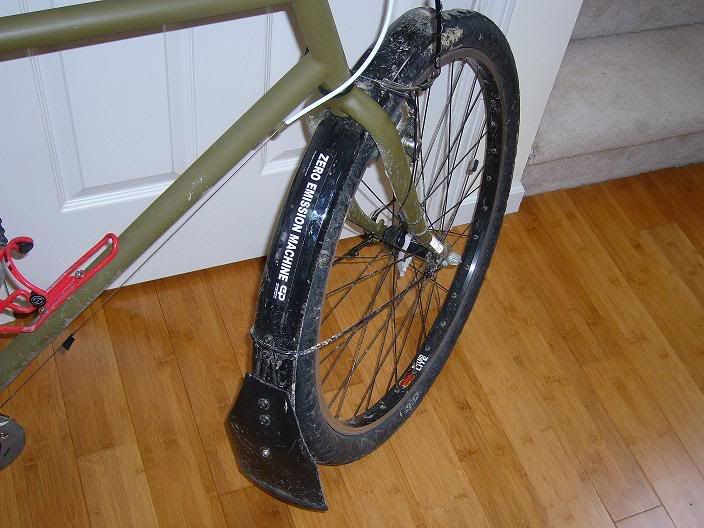
My commuter bike's front fender, with a short mud flap that offers some protection, but doesn't really help my shoes much.
A fender with a full-length mud flap, which should keep the slush out of your sneakers nicely.
Via MMBA.org
You can find full fender sets in anything from black plastic, such as I have on my commuter, to steel, fancy aluminum, carbon fiber or even bamboo, and in varioius widths to suit the tire size of your bike. I've tried a few different types over the years, and prefer either SKS Chromoplastics or Planet Bike Freddy Fenders. These seem to do the job and not cost a fortune (unlike the bamboo ones, which I have yet to see sell for under $100).

There are a couple of potential drawbacks to full-coverage fenders. If you have to transport your bike in a car, and take the wheels off to make it fit, the fenders continue to take up room even with the wheels removed. Also, if you have a singlespeed or internally-geared bike, the rear fender might make changing a rear flat a bit trickier. Fenders that fit too close to the tire can get clogged up with mud or snow in the wrong conditions, and any fender can get a rock or stick jammed in it, but it's a rare occurrence. One common complaint with smaller bike in particular is that the front fender can extend far enough back that when the wheel is turned too far your toes might bang up against it while pedaling. Normally, you wouldn't be turning the wheel that far while riding and many cyclists ride with toe-overlap without a problem, but some find it extremely disconcerting.


Monday, February 11, 2013

Roadside Repairs: Suddenly Singlespeed

Sometimes, especially on an old clunker, you might find yourself with a serious shifting problem. This can be because of damage from a crash, something that happened while your bike was parked or just failure of an old component. But for whatever reason your ability to change gears is compromised.

In these cases, the repair may be beyond what you can accomplish at the side of the road, so your best "get home" solution is to lock your bike into a usable gear, usually one in the middle of it's shifting range.

The key to this is knowing how limit screws work.
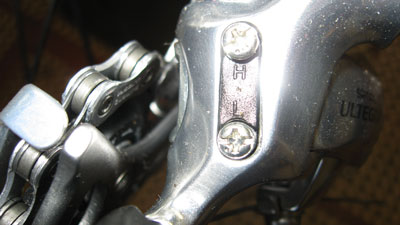
Rear derailleur with clearly labeled high and low limit screws
The limit screws control how far a derailleur can move at either end of its swing. If a limit screw is too far out, the derailleur can overshift and drop the chain off the cogs, if the screw is too tight, the chain will not be able to move from one cog to the next.

Normally, this is a bad thing, but if you're looking for a quick fix to get you home, tightening the limit screws so the chain is stuck on a particular cog is just the thing you need to do.

First, you have to make sure the shifter cable is not an issue. If the problem is a damaged or broken cable to begin with, you probably don't have to worry much, but if the problem stems from the shifter, you'll probably have to cut or disconnect the cable using your multitool.

Once you've done that, you can simply tighten down the limit screws, while turning the cranks so the chain moves, until the chain moves onto a cog near the middle of the gear range
This may be easiest to accomplish if you turn the bike upside down and balance it on the seat and handlebars.
If you're doing this with your rear derailleur, you probably only have to turn the High limit screw, as the spring tension of the derailleur will automatically force it towards the high (outer end, smaller cogs) end of the gear cluster. A few turns of the screw will bring the chain towards the middle of the gear range, rather than forcing you to ride in your high gear the whole way home.

If you're working on the front derailleur, and you have a triple crankset, the derailleur spring tension is set to move the chain towards the lowest cog, so you'd simply tighten the Low limit screw until you got the chain to sit in the middle chainring (if it's a double crankset, the lower gear is probably adequate to ride home anyway, but triple cranksets have a super-low "granny gear" range which can make moving at any speed difficult).

Of course, you'll have to re-set the limit screws when you're fixing the actual problem, but being able to perform this simple hack can save you a long walk home!